
How to Build a Postpartum Care Plan with a Doula

How to Build a Postpartum Care Plan with a Doula
When preparing for life after childbirth, many parents focus on the baby but overlook their own recovery and support needs. A postpartum care plan ensures you're ready for this critical period, often called the "fourth trimester", by prioritizing your physical recovery, mental health, and newborn care. Here's how working with a postpartum doula services can help:
- What is a postpartum care plan? A practical guide to manage your recovery, emotional well-being, and daily baby care.
- Why is it important? Most new parents in the U.S. lack structured support, with only 55% living near extended family.
- What does a doula do? They assist with feeding, light chores, emotional support, and more, bridging gaps in your support network.
- How to start? Assess your needs, outline goals for your doula, and plan for recovery, feeding, and sleep routines.
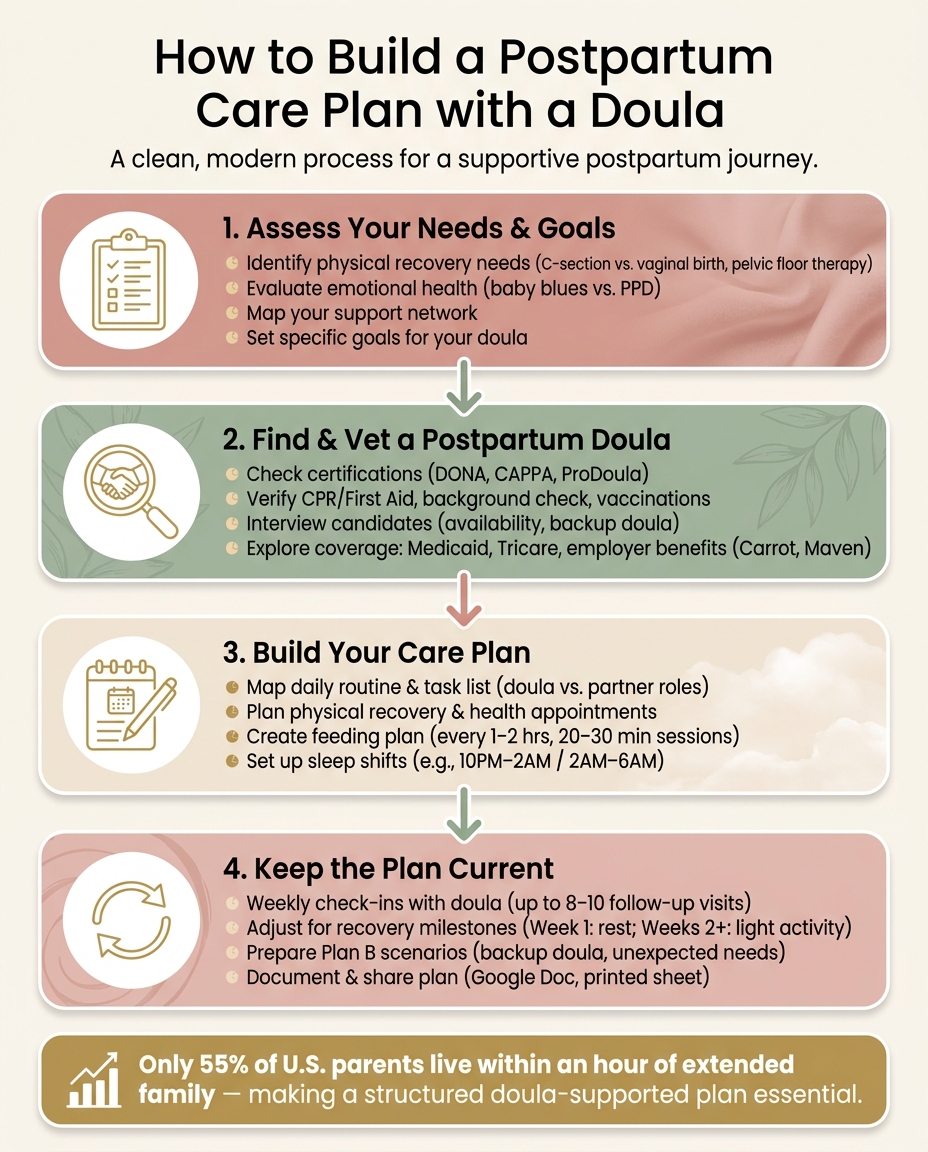
How to Build a Postpartum Care Plan with a Doula: 4-Step Guide
DocTalk - Episode 22: How Postpartum Doulas Support New Parents
sbb-itb-9ce2258
Step 1: Assess Your Needs and Goals
Before creating a postpartum care plan, it's crucial to evaluate your recovery needs, available support, and what you expect from a doula.
Identify Your Postpartum Recovery Needs
Your recovery will depend on your birth experience and medical history. For example, if you've had a C-section, you'll need to follow specific lifting restrictions and adjust movements to protect the incision site. Regardless of how you deliver, incorporating pelvic floor therapy into your plan can help restore core strength and address concerns like incontinence.
Don’t overlook emotional health. There's a big difference between the "baby blues" - mood swings that typically resolve within two weeks - and postpartum depression or anxiety, which requires professional care. If you’ve had a history of anxiety or depression, it’s wise to include regular mental health check-ins in your plan right from the beginning.
Take Stock of Your Support Network
Think about who in your life can provide practical help. Who can drop off meals? Who can stay for a few hours so you can rest? Research shows that having social support during the postpartum period can reduce the risk of postpartum depression.
It’s also smart to establish boundaries early, like deciding which visitors need to meet certain health requirements - such as getting Tdap, flu, or COVID vaccinations - before they meet your baby.
"If birthing couples get clear within the partnership and with their friends and family regarding what the expectations and preferences are, they get to bypass visitation pressure of any kind." - Esther Lavi, OTR/L, infant sleep coach, doula, and parent wellness specialist
Defining these roles can also help you figure out how your doula can fill in the gaps.
Set Clear Goals for Your Doula
Once you understand where your support network falls short, you can turn those gaps into actionable goals for your doula. Vague requests like "just help out" can lead to confusion, but clear, specific tasks set everyone up for success.
"A postpartum plan helps you prepare for the realities of recovery and newborn care by setting clear expectations for support, responsibilities, and self-care." - Elise Silver and Heather Russell, Silver Lining Doula
Here’s how common needs can translate into specific doula tasks:
| Your Need | Specific Doula Goal |
|---|---|
| Physical recovery | Preparing sitz baths, incision care guidance, pelvic floor therapy referrals |
| Infant feeding | Breastfeeding latch support, bottle-feeding logistics, nipple care |
| Sleep | Overnight care for the baby, daytime baby-watching so you can nap |
| Emotional health | Regular mental health check-ins, monitoring for signs of baby blues or PPD |
| Household | Light meal prep, laundry, coordinating visitor drop-offs |
Starting these conversations during your third trimester - before exhaustion and sleep deprivation kick in - allows you to prioritize what truly matters. Use this time to outline the specific tasks your doula will handle. With these assessments in place, you’re ready to move forward and find a postpartum doula who aligns with your clearly defined needs.
Step 2: Find and Work with a Postpartum Doula
Now that you’re ready to find a postpartum doula, the next step is choosing the right one and building a supportive partnership.
What Does a Postpartum Doula Do?
A postpartum doula is there to help families navigate the early weeks after a baby’s arrival. Krista Maltais, AdvPCD/PDT(DONA), explains:
"Certified Postpartum Doulas are professionally trained providers who care for families within the first 12 weeks after birth. They provide support to assist parents with perinatal education, completion of daily tasks, physical recuperation, newborn care, feeding support, sibling adjustment, coping skills, and evidence-informed resources."
In day-to-day life, this might involve assisting with breastfeeding, managing light household tasks, or helping establish sleep routines for your newborn. Some doulas specialize in nighttime care, focusing on overnight feedings and sleep, while daytime doulas often provide emotional support and practical guidance.
It’s important to understand what a doula doesn’t do. They aren’t medical providers, full-time nannies, or professional housekeepers. Instead, their role is to help you regain confidence and recover during this transitional period.
"Our goal is to build your confidence, not to replace you." - Newby Nurturing
How to Choose the Right Doula for Your Family
Once you understand what a postpartum doula does, it’s time to find one that suits your family’s specific needs.
Start by checking their credentials. Look for certifications from well-known organizations like DONA International, CAPPA, or ProDoula . If you need specialized support, consider doulas with additional training, such as Certified Lactation Counselors (CLC) or IBCLC credentials for feeding, or training from Postpartum Support International (PSI) for mood-related concerns.
Safety is another key factor. Confirm that the doula has up-to-date Infant CPR/First Aid certification, a clean background check, and current vaccinations . If you’re expecting twins or have a premature baby, ask about their experience in these areas.
When interviewing potential doulas, ask practical questions: Are they available during the day, at night, or both? Do they have a backup doula in case of emergencies? Don’t forget to request and check references. Platforms like Nestling can make this process easier by connecting you with caregivers who have already been screened for certifications, background checks, and references.
Also, check your benefits. Some employers offer postpartum doula support through programs like Carrot Fertility or Maven. Medicaid and Tricare may also cover doula services, but often require formal certification for reimbursement .
Once you’ve chosen a doula, make sure to clearly define their role and responsibilities so you can start building a plan tailored to your needs.
Define Roles, Boundaries, and Communication
Use your initial goals as a guide to set clear expectations. Outline specific tasks for the doula, such as washing bottles or folding baby clothes, and clarify what’s outside their scope, like deep cleaning.
A written contract is essential. It should include fees, services, and cancellation policies to ensure both parties are on the same page.
Communication boundaries are also important. Agree on “office hours” for non-urgent messages (e.g., Monday through Friday, 9 AM to 5 PM) and establish a reasonable response time, such as 24 hours for non-urgent inquiries. Define what qualifies as an urgent situation and how it should be handled, keeping in mind that doulas are not on-call 24/7 .
"When you're clear about what you offer, when you're available, and how you run your business, clients feel safer knowing exactly what to expect." - Darcy Sauers, Doula Coach
Step 3: Build Your Postpartum Care Plan
Once you've assessed your needs and chosen a doula, it's time to get your postpartum care plan down on paper. Think of this as a guide to help you navigate the early weeks - a plan that's structured enough to provide clarity but flexible enough to adjust as your baby grows and your recovery progresses.
Map Out a Daily Routine and Task List
A well-thought-out daily routine can be a lifesaver when you're running on little sleep and feeling overwhelmed. Work alongside your doula to divvy up responsibilities like diaper changes, bottle cleaning, laundry, and meal prep. A helpful tip: set realistic household expectations during the first few weeks. The priority should be rest and bonding, not keeping up with every chore. Your doula can help create a routine that focuses on what truly matters - your recovery and your connection with your baby.
Make sure to include short breaks for yourself, such as a quick walk or a warm shower, while your doula takes over baby care. These small moments can make a big difference in your day.
Once you've established your daily tasks, shift your attention to planning for your physical recovery and any necessary health appointments.
Plan for Physical Recovery and Health Appointments
Your care plan should go beyond the basics to address your recovery needs, especially since most mothers in the U.S. don't have a medical follow-up until the six-week postpartum visit. As Esther Lavi, OTR/L and Doula, explains:
"While the 6‑week visit is necessary... on its own it barely scratches the surface in terms of satisfying the physical, spiritual, emotional, and mental needs of a mother."
To bridge this gap, include key elements in your recovery plan, such as scheduled health appointments, pain management strategies, and essential recovery tools. A basic recovery kit might include items like a curved peri bottle, maxi pads, padsicles (frozen pads), and stool softeners. If you had a C-section, your doula can show you techniques like holding a pillow against your abdomen when standing or moving. They may also introduce traditional practices like Bengkung belly binding, which provides abdominal support as your body heals. Pelvic floor physical therapy is another option to explore, available both in person and online.
Create a Feeding and Sleep Plan
Newborns typically feed every one to two hours, with sessions lasting about 20 to 30 minutes. Decide on your feeding approach - whether it's breastfeeding, formula, or a mix of both - and set up a dedicated feeding station. Stock it with essentials like a comfortable chair, nursing pillow, burp cloths, nipple cream (antimicrobial coconut oil works well), a nightlight, and some high-protein snacks. If you're breastfeeding, aim to drink about half your body weight in ounces of water daily to support milk production.
For sleep, consider splitting the night into shifts, such as 10 PM to 2 AM and 2 AM to 6 AM, so each parent gets at least four hours of uninterrupted rest. Depending on your arrangement, your doula might handle overnight feedings entirely or help soothe your baby between feeds. Platforms like Nestling offer flexible doula options for both nighttime and daytime support, allowing you to tailor the coverage to your schedule. And keep in mind - newborns can be noisy sleepers, with lots of grunts and squeaks. Knowing this can help you avoid unnecessary wake-ups and get better rest.
Step 4: Keep the Plan Current as Things Change
Your postpartum plan isn't something you set once and forget. It's a guide that evolves alongside you and your baby. As your recovery progresses and your baby's needs shift, updating your plan ensures it stays relevant and effective.
Check In and Adjust Weekly
Take advantage of scheduled doula visits to review and tweak your plan. Postpartum doulas often offer multiple follow-up visits - sometimes as many as 8 to 10 - to address changing needs like breastfeeding challenges, sleep routines, and mental health concerns. Recovery unfolds in stages: during the first week, the focus is on healing, using tools like sitz baths and prioritizing rest. In the following weeks, as bleeding lessens, you can gradually introduce light activities like walking or core compressions. Let these physical milestones guide when and how you update your plan.
"Physical recovery can take several weeks, while emotional and hormonal adjustments may take months. Every parent's timeline is different." - Cradlewise
As you refine your routine, be ready to adapt to unexpected changes.
Plan for the Unexpected
Life with a newborn is unpredictable. Illness, feeding challenges, or other surprises can throw your plan off track. Preparing "plan B" scenarios ahead of time - ideally during your third trimester - can make these disruptions easier to manage. For instance, if your regular doula isn’t available or you suddenly need overnight help, Nestling offers flexible booking options to arrange backup support without the stress of last-minute scrambling. With only 55% of American parents living within an hour of extended family, having a dependable, on-demand support system is crucial. Write down these contingency plans so everyone involved knows how to respond.
Document and Share the Plan
Keep your plan accessible and organized. A shared Google Doc or a printed sheet on the fridge works well for tracking roles, meal plans, and sleep schedules. Share key parts of the plan with your partner, doula, and anyone else helping out. As Esther Lavi, Doula and Parent Wellness Specialist, explains: "If birthing couples get clear within the partnership and with their friends and family regarding what the expectations and preferences are, they get to bypass visitation pressure of any kind." Clear communication about your needs - like visitor guidelines and specific tasks - reduces the mental load of managing others' expectations, leaving you more energy to focus on recovery and bonding.
Conclusion: Setting Yourself Up for a Smoother Postpartum Period
Having a postpartum care plan with a doula ensures you’re never navigating the fourth trimester alone. By identifying your needs, securing the right support, creating a flexible routine, and leaving room for adjustments, you’re building a solid framework for this transformative time.
The postpartum period is a time of significant physical recovery and emotional adjustment. Childbirth brings immense changes, and a doula provides continuous, tailored support during those critical weeks when it’s needed most. This combination of recovery and steady assistance helps ease the transition into parenthood.
What makes this approach so effective is its emphasis on flexibility and recovery rather than constant action. As Elise Silver and Heather Russell of Silver Lining Doula & Nanny Services explain:
"Having a postpartum plan doesn't mean everything will go perfectly - it simply means you'll have a strong support system in place to help you adjust and recover."
Heng Ou, author and founder of Mother Bees, echoes this sentiment: "There's a lot of power, you know, in slowing down… slowing everything down and paying more attention." With a doula and a well-thought-out plan, you can embrace that slowdown, focusing on bonding with your baby and finding your rhythm as a parent.
To turn these steps into action, Nestling connects you with trusted postpartum doulas, lactation consultants, and infant care specialists, ensuring you have the support you need for recovery and newborn care.
FAQs
When should I hire a postpartum doula?
Hiring a postpartum doula early - ideally before or shortly after your baby is born - can make a big difference in your recovery and adjustment period. The first six weeks after birth are a critical time for healing, and a doula can offer much-needed support. This includes helping with newborn care, offering feeding guidance, providing emotional reassurance, and even assisting with light household chores. With this extra help, you can concentrate on recovering and building a strong bond with your baby.
How many postpartum doula hours do I need?
The amount of postpartum doula support you might need varies based on factors like your recovery process, how much rest you’re getting, and the type of help you prefer. Many families choose a combination of daytime shifts, often 4–6 hours long, and overnight shifts, which typically run from 9 p.m. to 7 a.m. Some opt for just a few days of help, while others may require several weeks, depending on how they’re adjusting and their specific care needs. Take time to evaluate your circumstances and plan for what feels right for you.
Will my insurance or employer benefits cover a doula?
Insurance coverage for doula services can be hit or miss. While some Medicaid programs in specific states and a few private insurance plans may include coverage for doulas, most private plans don't fully cover these services. To know for sure, you'll need to dig into the details of your specific insurance plan or check with your employer's benefits package. Since coverage often depends on your location and the provider, it's a good idea to carefully review your policy to understand what's available.









 Sign up with Google
 Sign up with Facebook