
Flexible Work Options for New Parents: What to Ask

Flexible Work Options for New Parents: What to Ask
Returning to work after having a child can be tough, but flexible work options make it more manageable. Whether it's remote work, part-time schedules, or compressed workweeks, these arrangements help balance career and family life. Here's what you need to know to make the right choice and secure the setup that works for you:
- Remote Work: Skip the commute and work from home. Saves time (about 72 minutes daily) and allows for better childcare management. Tools like Slack and project platforms help maintain productivity.
- Part-Time Schedules: Work fewer hours (20–30 weekly) to focus on family while staying in the workforce. Be clear about your availability and benefits adjustments.
- Compressed Workweeks: Work full-time hours in fewer days (e.g., four 10-hour days). Gain an extra day off weekly but prepare for longer workdays.
Key Steps:
- Check company policies: Review your employee handbook and HR guidelines.
- Understand legal rights: Know protections like the Family and Medical Leave Act (FMLA) or Pregnant Workers Fairness Act (PWFA).
- Ask the right questions: Discuss equipment, benefits, and workload adjustments with your employer.
- Present a clear proposal: Outline your plan, address potential concerns, and suggest a trial period.
Flexible work options are achievable with preparation and communication. Start early, be specific, and ensure all agreements are documented.
Types of Flexible Work Arrangements
Finding a work setup that fits your life and responsibilities as a parent doesn’t have to be overwhelming, especially when paired with postnatal care to support your transition. Options like remote work, part-time schedules, and compressed workweeks can help you balance your professional and personal life effectively.
Remote Work
Working remotely allows you to stay close to your child while eliminating the hassle of commuting. This extra time can be a game-changer for managing school pickups, sick days, or even naptime. In fact, 67% of working parents believe remote work better supports their families. On average, cutting out the commute saves workers 72 minutes daily, with nearly 20% of that time redirected to childcare.
"Remote work is not just making existing parents' lives easier. It is making it more feasible for people to start families in the first place." – Daniel Wolken, Career Advice Lead, DailyRemote
Many remote roles focus on results rather than strict hours, offering flexibility like split shifts that align with childcare needs. Tools like Slack, email, and project management platforms replace constant meetings, letting you work during times that suit your schedule. To minimize interruptions, consider setting clear boundaries - closing your office door or using a visual signal can help.
Part-Time Schedules
Part-time work trims your hours to around 20–30 per week, giving you more time for childcare while keeping your career moving forward. This could mean working mornings only, a few full days a week, or creating a schedule that accommodates family responsibilities.
With daycare costs averaging $18,420 annually, part-time work can also ease financial pressure by reducing the need for full-time childcare. Plus, in a recent survey by Hibob, only 13% of employees expressed a desire to return to a traditional five-day office schedule.
"I think we will have really failed working parents if we can't figure out how to move forward in a more flexible way that allows them to be the parents that they want to be." – Stacey Delo, CEO of Après
When requesting part-time hours, be specific. Instead of asking for general flexibility, propose a clear plan - such as ending your workday at 4:00 p.m. or being unavailable during certain blocks of time. This approach makes it easier to create a solution that works for both you and your employer.
Compressed Workweeks
A compressed workweek lets you fit full-time hours into fewer days. The "4/10" model - working four 10-hour days instead of five 8-hour days - is a popular choice. This setup gives you an extra day off each week for family time, errands, or personal appointments while maintaining a 40-hour workload. The extended weekends can be especially valuable for bonding with your child or catching up on other priorities.
sbb-itb-9ce2258
Reviewing Your Company's Policies
Before discussing flexible work options with your employer, start by reviewing your company’s policies. Look through the employee handbook, HR portal, or benefits guide for details about flexible work arrangements, leave duration, pay status, eligibility requirements, and how these benefits interact with others. If anything is unclear, reach out to your HR department for clarification. It’s also helpful to talk to colleagues who have successfully negotiated flexible schedules. Their experiences can give you a better idea of what has been approved in the past and what might work for you. Once you’ve gathered this information, confirm your eligibility and understand any legal protections that apply to you.
Check Eligibility Requirements
Eligibility for flexible work arrangements often depends on factors like how long you’ve been employed and the nature of your role. For example, under the Family and Medical Leave Act (FMLA), you must have worked for your employer for at least 12 months and logged 1,250 hours in the past year to qualify for job-protected leave. This law is applicable to both private and public employers with at least 50 employees within a 75-mile radius. Once you confirm your eligibility, it’s equally important to familiarize yourself with the legal protections available to you, especially as a new parent.
Know Your Legal Rights
In addition to your company’s policies, federal and state laws provide important protections. For instance, the Pregnant Workers Fairness Act (PWFA) requires employers with 15 or more employees to offer “reasonable accommodations” for pregnancy-related conditions. Similarly, the PUMP Act ensures that nursing mothers have access to private spaces and time to pump breast milk during work hours.
"It means women can ask for changes to their job to make it easier for them to succeed at work and also protect the health and safety of their pregnancy." – Daphne Delvaux, Attorney and Owner of Delvaux Law
Some states go beyond federal regulations by offering additional benefits. States like California, New York, Massachusetts, Washington, and Oregon provide paid family and medical leave programs, which typically include partial wage replacement for 6 to 12 weeks. Other states, such as New Jersey, Colorado, Minnesota, and Maine, have expanded parental leave protections. If needed, consider obtaining a doctor’s note to support requests for flexible hours or remote work due to pregnancy.
Questions to Ask Your Employer
Once you understand your company's policies and your legal rights, it's time to prepare specific questions for your employer. The questions you bring to the table will vary depending on the type of flexible work arrangement you're pursuing and how it aligns with your role. Thoughtful, detailed questions signal that you've carefully considered the logistics and are committed to ensuring the arrangement benefits both you and the company.
Questions About Remote Work
Start by asking about the equipment and software your company provides for remote work. Will they supply essentials like a laptop, monitor, ergonomic chair, or even an internet stipend? It's also important to clarify how your performance will be assessed - whether that's based on deliverables, hours logged, or overall output. Knowing the evaluation criteria upfront will help you align your efforts with company expectations.
You should also inquire about the process for requesting remote work and whether there are specific tools or guidelines you’ll need to follow. Confirm the primary communication channels - whether it’s Slack, email, or video calls - for staying connected with your team.
If you're thinking about reducing your hours, be sure to ask how this might affect your benefits and responsibilities.
Questions About Part-Time Schedules
One of the first things to clarify is what happens to your benefits if you switch to part-time status. For example, will your health insurance, retirement contributions, and paid time off remain the same, or will they be adjusted? Some companies offer full benefits to employees working 30 hours or more per week, while others prorate them based on your hours.
Ask about flexibility in adjusting your schedule as personal needs change. For instance, could you start with three days a week and increase to four after six months? You’ll also want to confirm whether your workload will be reduced proportionally or if you’ll still be expected to complete the same tasks in fewer hours. According to Peter Rahbar, intermittent use of FMLA or parental leave within the first year can also help ease the transition to a part-time schedule.
If you're considering a compressed schedule, focus on how it might impact team dynamics and project deadlines.
Questions About Compressed Workweeks
If a four-day workweek interests you, ask whether this arrangement is allowed and whether others in your company have successfully implemented it. Determine if the schedule would involve four 10-hour days or if there’s flexibility in distributing the hours across the week.
A key concern is how this schedule will affect team meetings and deadlines. Identify which recurring meetings might fall on your day off and whether they can be rescheduled or attended virtually. Also, ask if you’ll need to monitor emails or remain available for emergencies on your non-working day. To ease any concerns, suggest a trial period of three to six months to prove that you can meet deadlines and maintain team collaboration.
"The more you can show that any impact will be minimal or how it can be dealt with, the more likely it is your employer will agree".
How to Request Flexible Work
If you're ready to explore a flexible work arrangement, here's how you can formally approach the process and set yourself up for success.
Choose the Right Time
Timing can make all the difference when requesting a flexible work setup. One of the best opportunities to bring up your request is during a transition period - for example, when your company is adopting a hybrid model or revising its office policies. These moments often make employers more open to adjustments.
Aim to submit your request two to three months before your desired start date. This gives your employer enough time to adjust workloads or hire additional help if needed. If you're on parental leave, consider initiating the conversation before your return. Another good opportunity is during a scheduled performance review, where you can highlight how you've excelled while working remotely.
Planning ahead and showing you've considered the logistics will demonstrate your professionalism and commitment.
Present Your Proposal
Put together a clear, written proposal that outlines the details of your request. Include the specific working pattern you're asking for, your proposed start date, and how this arrangement might impact your team. Avoid vague terms like "flexibility" - instead, specify details such as your online hours, meeting availability, and how you'll manage deadlines.
It's important to frame your request as a way to maintain or improve your performance. Meghan Moravcik Walbert, Managing Editor at Lifehacker, explains:
"It's because you are so committed, because you want to always perform at the top of your game, that you'd like to propose some adjustments that will enable you to continue to meet (or exceed!) all of your goals".
Be prepared to address potential concerns. Explain how you'll stay connected with your team and ensure coverage for your responsibilities. Offering two or three practical options shows you're open to negotiation and makes it harder for your employer to dismiss your request outright.
Finally, suggest a trial period - typically three to six months - with a scheduled review date to evaluate the arrangement's success.
Get It in Writing
Once you and your employer agree on the terms, formalize the arrangement with a written agreement. This step is essential for avoiding misunderstandings and ensuring both parties stick to the terms. For non-exempt employees, this is especially important since employers need to track hours worked to comply with overtime laws.
Your agreement should clearly outline:
- The type of flexible work arrangement (e.g., remote, part-time, compressed schedule)
- Your schedule, including core working hours
- Communication expectations
- Any equipment or costs covered by the company
Include details about the trial period and conditions for modifying the arrangement. Make sure the document is signed by you, your manager, and any relevant department leaders. UC Berkeley emphasizes the importance of this step:
"Assuring that written documentation of the arrangement is in place with signatures by all involved parties... improves chances of a successful Flexible Work Arrangement".
Having everything in writing not only protects you but also provides a solid foundation for future discussions.
Comparing Your Options
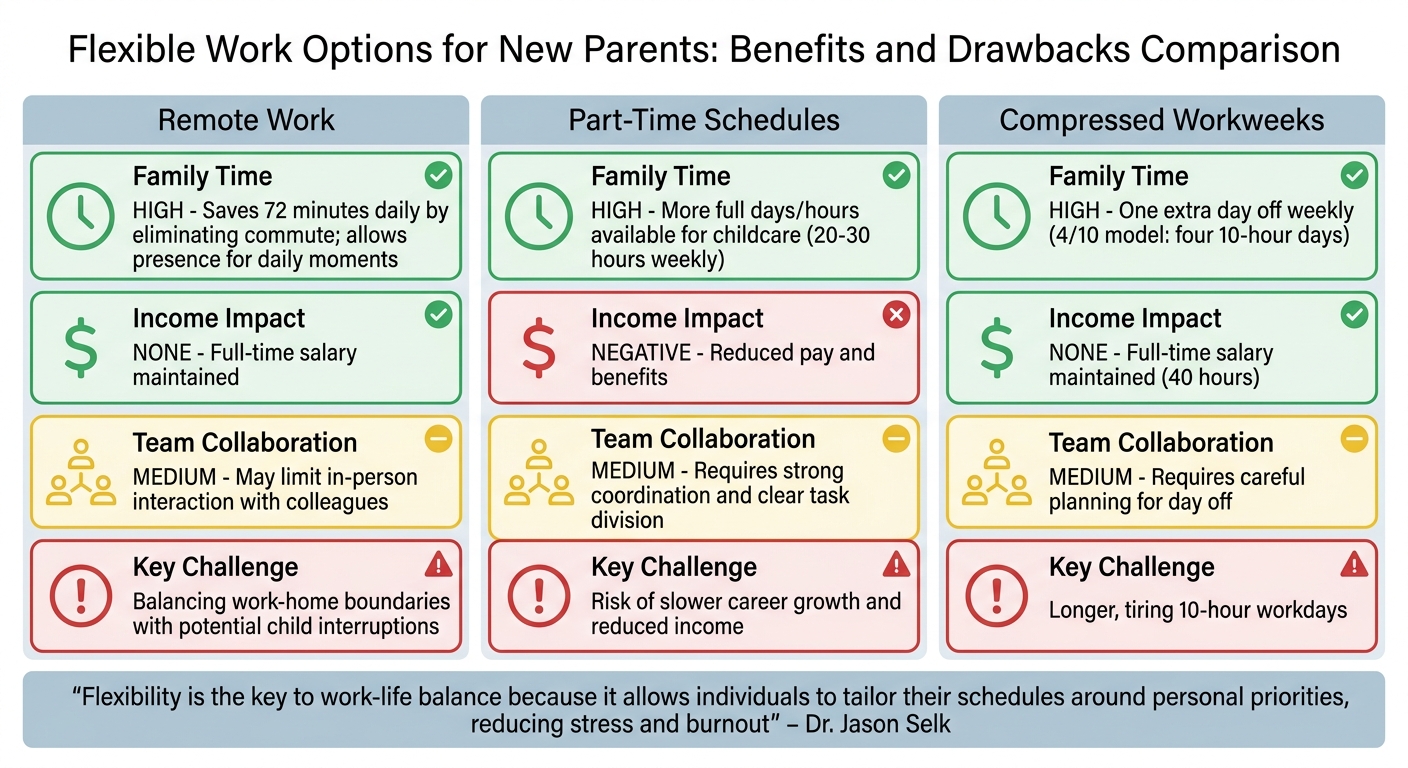
Flexible Work Options for New Parents: Remote, Part-Time, and Compressed Workweek Comparison
Benefits and Drawbacks
When deciding between remote work, part-time schedules, and compressed workweeks, it’s important to weigh how each aligns with your family’s needs and your career goals. Each option comes with its own set of perks and challenges, so understanding these differences can help you make a choice that works best for you.
Here’s a breakdown of how these three options stack up across key factors that matter to new parents:
| Factor | Remote Work | Part-Time Schedules | Compressed Workweeks |
|---|---|---|---|
| Family Time | High - cuts out the commute and lets you be there for daily moments | High - offers more full days or hours for childcare | High - provides a consistent extra day off each week |
| Income Impact | None - your full-time salary stays intact | Negative - usually comes with reduced pay and benefits | None - keeps your full-time salary by extending daily hours |
| Team Collaboration | May limit interaction with colleagues | Demands strong coordination and clear division of tasks with coworkers | Requires careful planning to manage your day off |
| Key Challenge | Balancing work and home life with potential interruptions from kids | Risk of slower career growth or reduced income | Longer, tiring workdays, often 10-hour shifts |
This side-by-side comparison shows that while all three options can help improve family time, they differ in how they affect income and collaboration with your team. The right choice will depend on what matters most to you - whether it’s maintaining income, maximizing time with your family, or staying closely connected with your team.
Dr. Jason Selk, Co-Founder of Level Up Game Plan, highlights the importance of tailoring your approach to your priorities:
"Flexibility is the key to work-life balance because it allows individuals to tailor their schedules around personal priorities, reducing stress and burnout".
As you prepare your proposal for flexible work, keep these trade-offs in mind to find the balance that best fits your situation.
Conclusion
Managing flexible work arrangements as a new parent can feel daunting, but it’s entirely achievable with the right approach. Start by building on your research - talk to colleagues who’ve successfully navigated similar arrangements. Their insights can provide you with both confidence and practical examples to strengthen your case.
When approaching your employer, focus on how flexibility can enhance productivity and contribute to the company’s success. Present a clear, detailed plan that outlines your proposed hours, communication methods, and deadlines. Offering a trial period can also make your request more appealing. As Lauren Smith Brody, author and founder of The Fifth Trimester, wisely notes:
"It's much harder for an employer to say no to 'can we try it?'"
Keep in mind that flexibility is not a one-size-fits-all solution - it evolves. As your child grows and your work responsibilities shift, plan regular check-ins with your manager to ensure the arrangement continues to work for everyone involved. Securing a written agreement is also crucial to avoid any potential misunderstandings.
The benefits of flexible work are well-documented. Research shows that 80% of employees feel more loyal to companies offering flexible options, and 95% of organizations report that remote work significantly impacts employee retention. By advocating for flexibility, you’re supporting not only your family’s stability but also your professional growth.
Finally, remember that balancing work and family life goes beyond creating flexible schedules. Transitioning back to work is just one part of the journey. Services like Nestling, offering expert postpartum and newborn care, can provide the additional support you need as you navigate this exciting new chapter.
FAQs
Which flexible work option is best for my role and childcare needs?
The best choice largely hinges on your job duties and how much flexibility you require. Many new parents gravitate toward these options:
- Remote work: Perfect for juggling work tasks while staying close to your child.
- Flexible hours: Options like staggered schedules or job sharing can accommodate feeding times or nap routines.
- Part-time schedules: A great fit if full-time work feels like too much to handle initially.
Having an open conversation with your employer can pave the way for a solution that works for everyone.
What should I include in a written flexible work proposal to my manager?
When putting together a proposal for a flexible work arrangement, it's important to outline the specifics of what you're asking for - whether that's working remotely, adjusting your hours, or adopting a compressed workweek. Be sure to explain how this setup would benefit both you and the company. For instance, you might highlight increased focus, better work-life balance, or reduced commute-related stress, all of which can lead to improved performance.
Address any concerns upfront, like how this change might impact productivity or teamwork, and share solutions to mitigate those challenges. For example, you could suggest regular check-ins or tools to stay connected with your team. If your manager seems hesitant, consider proposing a trial period to demonstrate the effectiveness of the arrangement.
Finally, emphasize how you’ll stay accountable - whether that’s through clear communication, meeting deadlines, or sharing progress updates. This will help reassure your manager that you’re fully committed to meeting expectations, even with a more flexible schedule.
How can I protect my benefits and job status when changing my schedule?
To protect your benefits and job status, make sure to communicate openly with your employer and get any schedule changes confirmed in writing. Have a conversation about how your adjusted schedule won’t affect your benefits or job security. It’s also a good idea to understand laws like the Family and Medical Leave Act (FMLA), which allows eligible employees to take up to 12 weeks of unpaid, job-protected leave. Keep a record of all requests and agreements to safeguard yourself during this process.









 Sign up with Google
 Sign up with Facebook