
How to Handoff Work Before Parental Leave

How to Handoff Work Before Parental Leave
Preparing for parental leave doesn't have to be stressful. A solid work handoff plan ensures your responsibilities are covered, your team is ready, and you can focus on your family without worrying about work piling up. Here's how to do it:
- Plan Early: Start 3–4 months before your leave to finalize dates, list tasks, and prioritize responsibilities.
- Create a Handoff Document: Include a summary of your role, key tasks, contacts, deadlines, and troubleshooting guides.
- Train Your Team: Hold meetings to review the plan, assign tasks, and provide training for complex workflows.
- Set Boundaries: Define your availability during leave, set up out-of-office replies, and clarify what counts as an emergency.
- Prepare for Your Return: Discuss flexible work options, schedule re-onboarding, and outline a plan to ease back into your role.
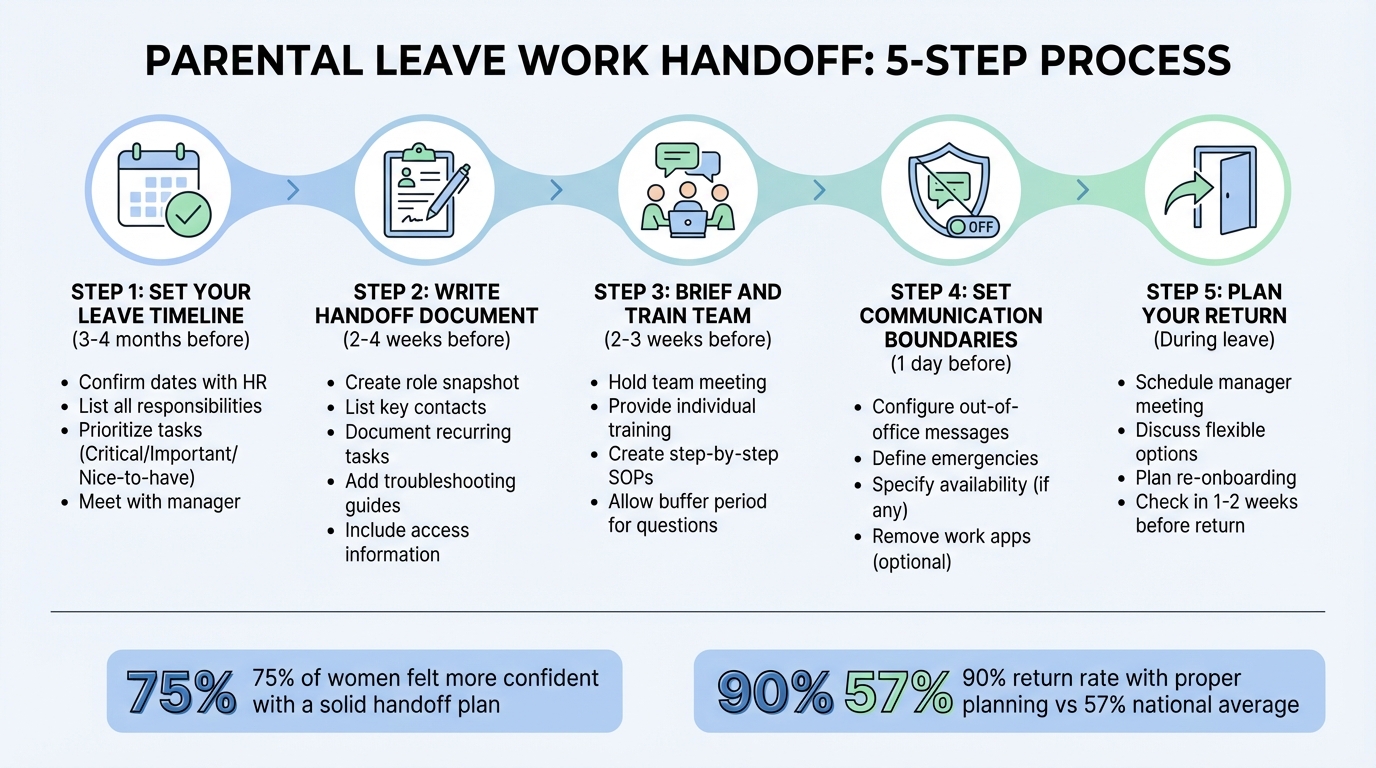
5-Step Parental Leave Work Handoff Process Timeline
Step 1: Set Your Leave Timeline and Identify What Needs Coverage
Confirm Your Leave Dates with HR
Plan a meeting with HR about 3–4 months before your expected leave date to finalize the details of your time off. It’s essential to understand how different leave options work together. For example, the Family and Medical Leave Act (FMLA) provides up to 12 weeks of unpaid leave for employees who qualify. This applies to companies with 50 or more employees, provided you’ve worked there for at least 12 months and logged 1,250 hours in the past year. In addition, some states offer Paid Family Leave (PFL) programs that might supplement FMLA, and your company could have policies that go beyond these federal or state requirements.
Be sure to ask about your pay structure during leave and how your health insurance premiums will be managed if your leave is unpaid. Request all agreements in writing, including confirmed leave dates, pay details, and any benefits arrangements. It’s also a good idea to discuss flexibility options, like phased return-to-work programs or adjusting your return date in case your baby arrives earlier than expected.
Once your leave dates are set, the next step is to organize your responsibilities.
List and Prioritize Your Responsibilities
Start by creating a detailed inventory of your tasks. This should include recurring duties, ongoing projects, tools you use, key contacts, and any required approvals. Write everything down in clear checklists or standard operating procedures so that someone stepping into your role can follow along easily.
After compiling your list, divide tasks into categories based on their importance. Critical tasks are those that could disrupt revenue, compliance, or payroll if left undone. Important tasks affect team performance or deadlines, while nice-to-have tasks are longer-term improvements that can wait until you return. For each task, estimate how much time it takes to complete, and note any specialized skills or access permissions needed.
Here’s a framework to help you organize your tasks:
| Task Category | Definition | Coverage Action |
|---|---|---|
| Critical | Breaks revenue, compliance, or payroll | Must be assigned to a trained team member |
| Important | Impacts team performance or deadlines | Should be covered if possible |
| Nice-to-have | Long-term or optimization tasks | Can be paused until your return |
| Deadline-Sensitive | Fixed-date tasks during leave period | Requires specific scheduling in the handoff |
Schedule a meeting with your manager to go over this prioritized list. Together, decide which tasks can be paused, which ones need to continue, and who will take responsibility for each. Aim to build in a buffer period of 1–2 weeks before your leave starts so you can address any questions or issues that come up during the handoff process.
sbb-itb-9ce2258
Step 2: Write a Clear Handoff Document
After identifying what needs to be covered, the next step is creating a single, well-organized document that your team can rely on while you're away. Think of this as the playbook for whoever takes over your responsibilities. The goal here isn't to write a novel - it's to provide clarity and ensure nothing falls through the cracks. This document acts as a bridge between your current workflow and the team's ability to execute in your absence.
Start by dividing the document into clear sections for easy navigation. Begin with a Role Snapshot - a brief summary (one to two sentences) of your position and key metrics. Follow this with sections for Key Contacts, Recurring Tasks, and Active Projects.
Consistency is key when formatting each section. For recurring tasks, specify the "trigger" that signals when action is needed, like "the first Monday of each month" or "when an invoice arrives in the shared inbox." This eliminates guesswork. Keep Standard Operating Procedures short and to the point - one page per task, using numbered steps rather than long paragraphs.
"Your handover document will become the roadmap for whoever steps into your role." - Bright Horizons
Add a troubleshooting section for common issues and include a decision log to explain why certain choices were made on current projects. This helps your team make informed decisions without needing to contact you. For more complex processes, include screenshots or short video recordings - visual aids can often explain things better than text alone.
Centralize access information in a "Where Everything Lives" section. This should list systems, shared drives, and vendor portals your team will need, along with the required permissions. Don’t include actual passwords; instead, note where credentials are stored, like in your company’s password vault. Aim to finalize this document two to four weeks before your leave so your team can test it while you're still available to answer questions.
Here’s how to break down your handoff document into actionable parts:
List Current Projects and Their Deadlines
Once your document is organized, outline all active projects and their deadlines. For each project, include its current status, expected outcome, and the next three specific actions that need to happen. Be sure to include exact due dates for each step so your team knows what’s urgent and what can wait.
Use the priority framework from Step 1 to categorize projects. For those with deadlines during your leave, highlight whether the dates are flexible or fixed. Add a column for potential risks or blockers and provide suggested workarounds to keep things moving smoothly.
Name Who Will Handle Each Task
Every task and project should have a clear owner. Avoid vague assignments - assign one specific individual to each responsibility. Include their name and contact details so colleagues know exactly who to reach out to.
Define escalation procedures and decision-making boundaries. Make it clear what your coverage team can approve independently and what requires escalation to your manager or another stakeholder. A RACI chart (Responsible, Accountable, Consulted, Informed) can help clarify roles without lengthy explanations.
Add Links to Files and Resources
Provide direct links to folders, documents, and templates your team will need. If your company uses a centralized knowledge base, include those links too. For systems requiring special access, note the necessary permission levels and highlight any shared inboxes or calendars your team should monitor. If files are stored in multiple locations, specify which version is the authoritative source.
Step 3: Brief and Train Your Team
With your handoff document ready, it’s time to bring your team up to speed on their responsibilities. A well-structured meeting can prevent misunderstandings and ensure everyone knows their deadlines and decision-making roles. Aim to hold this meeting 2–3 weeks before your leave, giving plenty of time for follow-up questions.
Start by confirming your leave dates and introducing the primary point of contact. Walk the team through the key points of the handoff document, demonstrating any complex systems or workflows. Wrap up with a Q&A session where team members explain their new duties - this is a quick way to spot any confusion. According to research, 75% of women in the UK reported feeling more confident about taking maternity leave when they had a clear handover plan and trusted their replacement.
Make sure everyone has the necessary logins, file access, and tools to handle their tasks independently. If your company uses a RACI chart (Responsible, Accountable, Consulted, Informed), display it during the meeting to visually clarify project ownership. This meeting lays the groundwork for targeted training and detailed workflow guidance.
Conduct a Team Meeting to Review the Plan
Assign deadlines and responsibilities clearly. Discuss potential challenges and review your troubleshooting guides together. Encourage colleagues to explain their new responsibilities back to you. This not only reinforces their understanding but also helps uncover any lingering uncertainties before you step away.
Offer Individual Training for Complex Tasks
For tasks that require more than a group overview - such as technical processes or responsibilities with multiple variables - schedule one-on-one sessions lasting 30 to 60 minutes. During these sessions, have your backup perform the task while you guide them. Plan a buffer period 1–2 weeks before your leave so your backup can take over responsibilities while you’re still available to answer questions. For particularly intricate workflows, consider recording a screen walkthrough using tools like Loom or SnagIt. These recordings provide a handy reference for your colleagues later on. Follow up with written SOPs to reinforce the training.
Create Step-by-Step Instructions
Break down recurring tasks into clear, one-page Standard Operating Procedures (SOPs). Each SOP should include:
- A trigger to indicate when to start (e.g., "the first Monday of each month").
- Numbered steps to follow.
- Verification criteria to confirm the task was completed correctly.
For common issues, include decision trees and specify who to contact if additional help is needed.
"A strong handover plan is one of the fastest ways to protect your reputation after you resign because it proves you're leaving professionally, not leaving problems behind." - RequestLetters
Focus your instructions on tasks that are frequent, complex, or have a higher risk of errors. Clearly define what “done” looks like for each SOP so your replacement can independently verify their progress.
Step 4: Set Communication Boundaries for Your Leave
Defining clear boundaries during parental leave helps protect your time while ensuring your team knows how to handle any pressing issues. Studies show that 67% of women worry about job security and continuity during maternity leave. A solid communication plan can ease these concerns by outlining when you'll be available - or, more importantly, when you won't.
Start by deciding how connected you want to be. Will you be entirely offline for the duration of your leave, or will you check in periodically after the first month? Once you've made this decision, let your manager, HR, and team members know. This prevents "boundary creep", which happens when responding to one email signals a willingness to be more accessible than you intended.
"A well-crafted maternity leave out of office message is more than just a courtesy. It's actually a powerful tool for you to protect your space during this pivotal time in your life."
– wrk360
Configure Out-of-Office Messages
Set up automatic replies the day before your leave begins. Include your leave's confirmed start date and tentative return date. Use bold text and bullet points to make important details stand out. Provide alternate contacts for specific areas, listing their names, roles, and email addresses - for example, one person for client support and another for marketing inquiries.
For non-urgent matters, encourage senders to follow up after your return. Here's a sample template:
"Thank you for your message. I am currently on parental leave and will return on [Date]. I will not be monitoring email during this time. For urgent matters, please contact [Name] at [Email]. Thank you for your patience."
Draft this message ahead of time and coordinate with your alternate contacts to ensure everyone is on the same page.
Decide What Counts as an Emergency
Once you've defined your availability, clarify what qualifies as an emergency. Emergencies should involve high-priority situations where your input is absolutely necessary. Non-critical issues should go to your designated backups.
In your out-of-office reply, specify what constitutes an "urgent matter" or direct urgent inquiries to a team coordinator. For instance, you might state that emergencies include major client escalations or critical system failures that backups cannot resolve. This helps your team feel confident in managing issues while respecting your time away.
Specify If and When You'll Be Reachable
If you plan to stay minimally connected, create a clear schedule. For example, you might disconnect entirely for the first four weeks, then schedule weekly check-ins. Use a separate communication channel, like text, for true emergencies.
"Choose discomfort over resentment when you're deciding whether or not to check in or respond."
– Lori K. Mihalich-Levin, Founder of Mindful Return
If you prefer full disconnection, remove work email and messaging apps during your leave. Sticking to your boundaries is key - responding to one email can open the door to more contact and blur the lines you've set. Discuss these terms with HR and your manager well in advance, and consider drafting a formal document that outlines when and how you can be reached, if at all. This ensures everyone is aligned before your leave begins. Once your leave starts, focusing on postnatal care and recovery becomes the priority.
Step 5: Plan for Your Return to Work
A smooth return to work after leave is just as important as ensuring things run well during your absence. Research highlights that 90% of new parents using the Maven platform returned to work after their leave, compared to a national average of 57% in the U.S.. This stark difference often comes down to thoughtful preparation and open communication. By planning ahead, you can step back into your role with confidence and maintain your career trajectory.
Meet with Your Manager
Schedule a meeting with your manager 3–4 months before your leave. Use this time to revisit your job description and discuss any potential changes to your role while you're gone. This is also a great opportunity to align on your career goals and how your return-to-work plan can support your professional growth.
"Since working parents - especially working mothers - often face discrimination and professional setbacks when choosing to start a family, this pre-leave review process can provide valuable insight and lay the groundwork for an enthusiastic return to work."
– Maven Team
After the meeting, follow up with an email summarizing key points, including timelines, any role adjustments, and agreed-upon check-in dates. A good practice is to schedule a touchpoint two-thirds of the way through your leave to confirm your return date and address any adjustments you might need.
Discuss Flexible Return Options
To make your transition back easier, consider discussing flexible work arrangements with your employer. Familiarize yourself with your company's FMLA policies. If you're eligible and your company has 50 or more employees, you may be entitled to up to 12 weeks of unpaid leave. Suggest a phased return, such as starting with a three-day workweek or remote work, and put your proposal in writing.
"Many returning employees opt for phased returns or reduced hours, so working with them to create a schedule that accommodates both their needs and the business' priorities is key."
– The Work Crowd
You might also request to keep interim support temporarily in place once you return. This can help manage overflow tasks while you focus on settling back in. It's worth noting that companies offering 12 weeks of paid maternity leave see 70% less turnover, so your employer likely has a vested interest in supporting your transition.
Outline Ideas for Projects After Your Return
Create a detailed re-entry plan that outlines how you'll ramp back up to full capacity. Add a section to your handoff document titled "Re-Onboarding Expectations" to specify how you'd like to be brought up to speed on ongoing projects. Plan to spend your first week catching up through meetings and one-on-ones with key team members. About 1–2 weeks before your return, check in with your manager to get a high-level overview of any major updates or changes within the company. This organized approach ensures you'll regain momentum without feeling overwhelmed on your first day back.
Wrapping Things Up
Preparing to hand off your work before parental leave doesn’t have to be overwhelming. Starting 3–4 months in advance, creating clear documentation, training your team, and setting firm boundaries can help you protect both your career and your peace of mind. In fact, research highlights that 75% of women felt more confident about taking leave when they had a solid handoff plan in place.
"A well-planned handover makes sure your projects and responsibilities are taken care of while you're away. That will give not only you but your team peace of mind, and it can ease your return to work."
– Robert Half
This isn’t just about keeping projects on track - it’s about building trust and teamwork that will benefit everyone when you return. By covering all the details, you ensure business continuity and give yourself the freedom to focus on your family during this important time. Plus, it sets the stage for a smoother transition back to work.
FAQs
Who should cover my work while I’m on leave?
Getting ready for parental leave? It's crucial to have a solid plan in place to ensure everything runs smoothly while you're away. Start by creating a detailed leave plan and sharing it with your manager and team. This plan should outline:
- The duration of your leave: Be clear about your start and end dates.
- Key check-ins: Specify any updates or milestones that might require attention during your absence.
- Your return date: Let everyone know when you’ll be back to resume your responsibilities.
Preparing for a Seamless Transition
Begin preparations early to avoid last-minute stress. Here’s how:
- Delegate tasks: Assign your responsibilities to capable colleagues and ensure they're comfortable with their new duties.
- Document processes: Write down the key steps for your regular tasks so others can follow them easily.
- Train your backup: Take time to walk your colleagues through your role, answer questions, and clarify expectations.
Finally, provide clear handover documents. These should act as a guide for whoever is stepping into your role, ensuring they have everything they need to keep things running without interruptions. A little preparation now can make a big difference later!
What should I include in a handoff document?
An effective handoff document is your roadmap to ensuring a seamless transition. It should clearly outline your responsibilities, ongoing tasks, and provide detailed instructions like standard operating procedures (SOPs) and where to find essential resources. Be sure to include deadlines and assign task owners to keep everything on track.
To make things even smoother, schedule short knowledge-transfer sessions to address any questions or provide additional context. A well-thought-out handoff not only minimizes disruptions but also helps interim staff get up to speed quickly, ensuring everything runs smoothly during your parental leave.
How do I set boundaries so I’m not contacted during leave?
To ensure you’re not disturbed during your time off, it’s essential to communicate your unavailability and establish a plan for handling urgent situations.
- Be upfront about your leave: Inform your manager and team well in advance about your time away. Clearly set expectations regarding your availability (or lack thereof).
- Prepare for emergencies: Designate someone to handle pressing issues or create a clear protocol for how critical matters should be addressed while you're out.







 Sign up with Google
 Sign up with Facebook