
5 Tips for Negotiating Flexible Work After Leave

5 Tips for Negotiating Flexible Work After Leave
If I want flexible work after leave, I need to make a clear work plan, not just a personal request. That means I should decide what I need, show my past results, check company rules, answer coverage questions, and ask to test the setup for 60 to 90 days.
One stat says nearly 25% of new mothers in the U.S. return to work just two weeks after giving birth. That’s why this talk needs to be direct. I’m not asking for “flexibility” in general. I’m asking for a work setup that fits my job, my child care schedule, and my team’s day-to-day needs.
Here’s the short version:
- I need to know my must-haves before I talk to my manager.
- I should ask for one clear schedule, not a vague idea.
- I need to back up the request with my work record.
- I should check HR rules, leave rules, and pumping rights under the PUMP Act.
- I need to answer likely concerns about availability, travel, and child care gaps.
- If my manager is unsure, I can ask for a written trial period.
Quick Comparison
| Tip | What I should do | Why it matters |
|---|---|---|
| Know what I need | Sort must-haves from nice-to-haves | Stops me from asking for a setup that fails at home or work |
| Show my value | Bring results, wins, and proof of output | Gives my manager a work-based reason to say yes |
| Build a clear proposal | List schedule, coverage, backup care, and reporting | Makes the ask easier to review |
| Frame the talk well | Bring it up before I return and keep it work-focused | Gives my manager time to plan |
| Offer a trial | Suggest 60 to 90 days and put terms in writing | Lowers the risk for both sides |
This article boils down to one idea: the more specific I am, the easier it is for my employer to picture saying yes.
sbb-itb-9ce2258
Know What You Need Before You Negotiate
Before you talk to your manager, get clear on what you need. If you don't have a solid picture of your day, it's easy to ask for a setup that falls apart at home or at work.
Separate must-haves from nice-to-haves
Some parts of your schedule are fixed. Daycare hours, commute limits, and pumping breaks usually aren't things you can just "figure out later." Other parts leave more room to move, like remote days or backup care. The goal is simple: narrow your request to one option that can work.
| Category | Must-Have (Nonnegotiable) | Nice-to-Have |
|---|---|---|
| Schedule | Fixed start/end times for daycare | Temporary four-day workweek |
| Location | Remote days to manage home routine | Occasional work-from-home Fridays |
| Lactation | Private space + pumping breaks every 3 hours | On-site pump access |
| Childcare | Confirmed primary care enrollment | Employer-sponsored backup care |
Let these priorities shape the proposal you bring to your manager. Think of this list as the backbone of your request.
Map your childcare and feeding schedule
Write out what your day actually looks like before you draft anything. What time does daycare open? How long is your commute when traffic is normal, not ideal? If you're pumping, plan for breaks every three hours and confirm that your workplace can provide a private, non-bathroom space under the PUMP Act.
It also helps to line up feeding times with your childcare provider so the plan fits your commute and work hours. These fixed points give you the framework for the hours, location, or break times you ask for.
Once the day-to-day pieces are on paper, it gets much easier to build a schedule your manager can review.
Choose one schedule you can explain clearly
Managers can respond to a clear plan much more easily than a vague idea. Show up with something specific, like "I'd like to work 8:00 a.m. to 4:00 p.m., remote on Tuesdays and Thursdays" or "I'm proposing a temporary four-day workweek." That kind of ask shows you've done the homework, and it gives your manager something direct to approve.
"Nestlé allows me the flexibility to manage my schedule and accommodate what I need and the boundaries I set... I have had to decline meetings due to daycare drop off/pick-up, and I have never had someone complain." - Mercedes, Manager HR, Nestlé IT
Once your schedule is clear, use your performance record to support the ask.
1. Know Your Value and Document Your Performance
Once you know your schedule, the next step is simple: show why you’re worth the flexibility.
Your performance record is the base of any flexible-work request. Bring concrete results, recent wins, and proof that you can deliver steady work. Make it easy for your manager to see the case and back your request.
"Your employer knows your work ethic and work product. You have also built up some kind of equity so that people know your strengths and are willing to work with you." - Priya Amin, Co-founder, Flexable
That record matters. It helps show that flexible work can support retention, continuity, and fewer disruptions. Breastfed children get sick less often, which can reduce unplanned absences.
If you stayed in touch with your team during leave, mention that too. It shows continuity and makes your request feel grounded in how you already work.
Then connect that record to your company’s policy and a clear proposal.
2. Review Company Policies and Build a Specific Proposal
Start with your handbook and HR policies. Look at parental leave, phased return options, and flexible work rules. Those documents give you the guardrails for your request, and they can make your manager’s decision much simpler.
The goal is to turn policy details into one clear ask that feels specific, realistic, and easy to approve. Don’t keep it vague. Spell out what you want your schedule to look like and how the work will get done.
If you’re nursing, add your pumping breaks and private-space needs to the proposal. That part should be stated plainly so there’s no confusion later.
It also helps to connect policy fit with your own track record. If your request lines up with company rules and shows that you’ve thought through coverage, communication, and child care, it becomes much easier for a manager to say yes.
Build your proposal around a few core pieces:
| Proposal Component | What to Include |
|---|---|
| Schedule | Specific days, hours, and location (for example, remote Fridays and in-office Monday through Thursday from 9:00 AM to 5:00 PM) |
| Coverage | Who handles tasks during off-hours or adjusted shifts |
| Pumping Needs | Break frequency, duration, and space requirements (if applicable) |
| Backup Care | Your plan for unexpected child care gaps |
| Progress Reporting | How you'll track and communicate your output |
A good proposal should cover your exact schedule, your coverage plan, your backup-care plan, and how you’ll stay accountable. Think of it this way: you’re not just asking for flexibility. You’re showing how that setup will work day to day.
3. Pick the Right Time and Frame the Conversation Professionally
Once your proposal is specific, bring it up at the right time. Don’t wait until the last minute. Make the request before your return date so your manager has time to look it over, check with HR, and plan with the team. Starting early also shows that you’re organized and thinking ahead.
Pick a calm moment when your manager can give the conversation full attention. Keep the focus on coverage, output, and timing. If you’re asking for remote Fridays, for instance, explain how deadlines will stay on track and how handoffs will work. Be direct about pumping breaks too. Share the expected frequency and duration upfront. Under the PUMP Act, most U.S. employers are federally required to provide reasonable break time and a private, non-bathroom space for employees to express breast milk for up to one year after a child's birth.
Close with a clear next step. Say when you’ll send the written proposal and when you’ll follow up. That makes the process easier for both sides and sets up the next part of the discussion: any trade-offs or compromises your manager may bring up.
4. Address Employer Concerns and Offer Practical Compromises
Once your proposal is on the table, expect some pushback.
That’s normal. Most concerns tend to come back to the same few things: availability, postnatal care, and team coverage. The goal isn’t to argue. It’s to show that you’ve thought through the work side of this and already have a plan.
Start with job impact. If travel is part of your role, offer a local-only setup for a set period. That gives your employer a clear path instead of an open-ended change.
If childcare falls through, explain exactly what happens next. Who do you call? How do you handle urgent tasks? Keep it framed as a work plan, not just a personal issue. Spell out your backup option and how you’ll keep the team from getting thrown off course.
Use direct, specific responses like these:
| Employer Concern | Your Response |
|---|---|
| Availability during core hours | Define blocked times, such as daycare drop-off and pick-up, and confirm you're reachable for high-priority matters outside those windows |
| Travel or client-facing commitments | Propose local-only work for 12 months, then reassess |
| Childcare emergencies disrupting work | Name your backup contact and explain how you'll cover urgent tasks |
| Pumping breaks affecting productivity | Set 20- to 30-minute breaks every three hours and note the required private space |
The more specific you are, the easier it is for your employer to picture how this would work in practice. That also makes the next move much simpler: proposing a trial period.
5. Propose a 60- to 90-Day Trial and Get It in Writing
If your manager isn’t ready to say yes, suggest a 60- to 90-day trial. That gives both of you a set window to test the setup, see how it goes, and look at the results without treating it like a forever decision. Set the review date before the trial starts so there’s a clear time to check progress and build a record of your work.
"Be a monument of productivity. Follow through with every minutiae of your job... and show your boss you are more than capable of working efficiently." - Dana Ranill, Matador Network
During the trial, stay visible. Use your messaging tool, keep your manager in the loop on key emails, and track what you finish and the results you produce. Out of sight can turn into out of mind fast, so make your work easy to see.
Put the trial terms in writing to prevent mix-ups later. Keep it simple and specific. Include:
- Core hours
- Remote days
- Lactation breaks
- Check-in schedule
- Success metrics
If you’re nursing, spell out 20- to 30-minute lactation breaks every three hours.
Flexible Work Options at a Glance
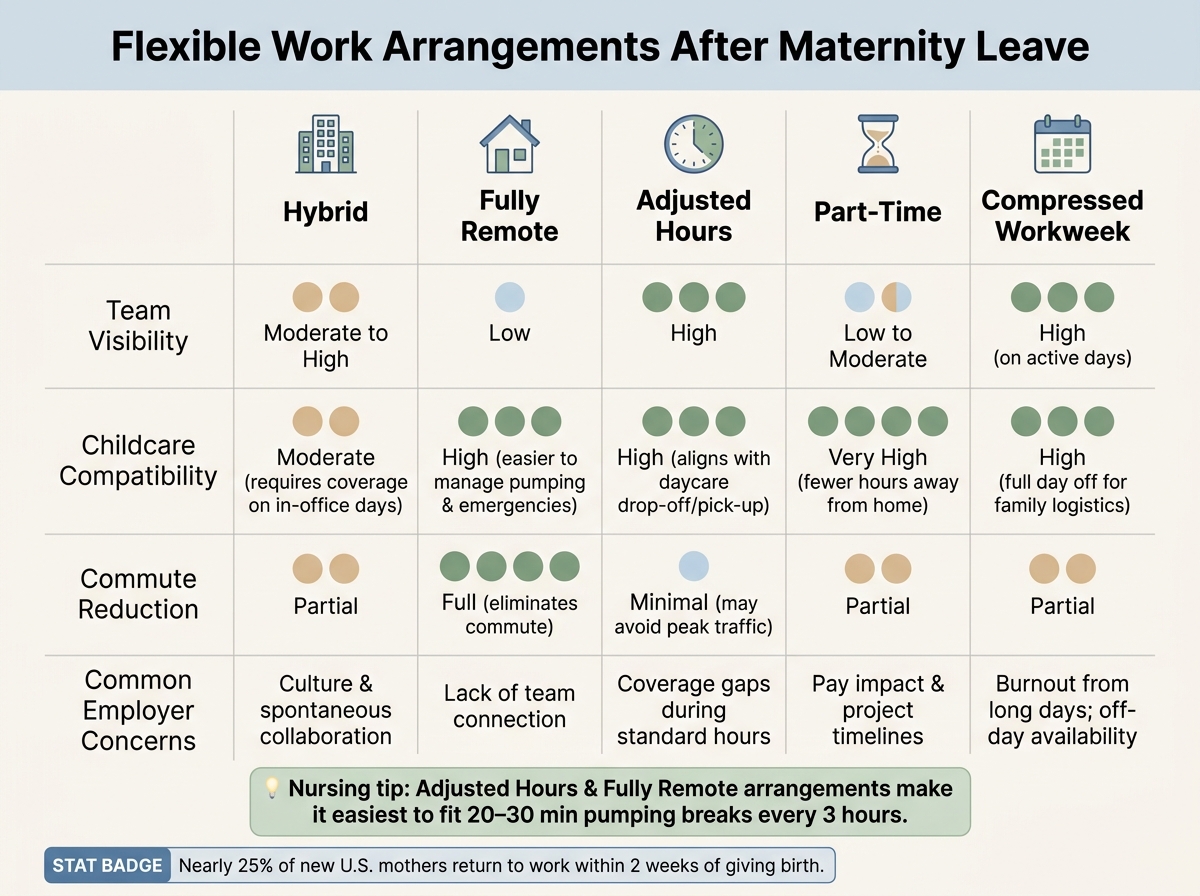
Flexible Work Arrangements After Maternity Leave: A Side-by-Side Comparison
Once you know your non-negotiables, this comparison can help you zero in on the strongest ask.
Compare common schedule types
Knowledge-based roles tend to work well with remote or hybrid setups. Fixed-coverage roles often make more sense with adjusted hours or a compressed workweek.
Every option has tradeoffs. Some affect visibility. Others change coverage or add pressure at home.
| Arrangement | Team Visibility | Childcare Compatibility | Commute Reduction | Common Employer Concerns |
|---|---|---|---|---|
| Hybrid | Moderate to high on office days | Moderate; requires coverage on in-office days | Partial | Maintaining culture and spontaneous collaboration |
| Fully Remote | Low; relies on digital communication | High; easier to manage pumping and emergencies | Eliminates commute | Lack of team connection |
| Adjusted Hours | High; overlaps with core hours | High; aligns with daycare drop-off and pick-up | Minimal, though you may avoid peak traffic | Coverage gaps during standard business hours |
| Part-Time | Low to moderate | Very high; fewer hours away from home | Partial | Proportional pay and impact on project timelines |
| Compressed Workweek | High on active days | High; provides a full day off for family logistics | Partial | Burnout from long days; availability on the off day |
Match each option to your home and team needs
Use the table to find the option that fits your role and feels easiest for your employer to say yes to.
If you're nursing, adjusted hours and fully remote work can make it easier to fit in 20- to 30-minute pumping breaks every three hours. When your schedule already leaves room for those breaks, day-to-day planning gets a lot smoother for you and your team.
If your employer offers a phased return, treat it like a trial run. It gives you a chance to see what works before asking to make the change permanent.
Conclusion
Keep your ask specific, measurable, and tied to what the team needs. Bring it up early so your manager has time to sort out coverage. After the trial, look at the results, not just opinions, to decide what should happen next. Then use the trial review to lock in the arrangement or make clear adjustments.
A clear plan that’s been tested on the job gives both you and your employer a better way forward.
FAQs
What if my manager says no?
If your manager says no, keep it professional. Ask what, exactly, they’re concerned about. Then request a follow-up meeting so you can pin down which parts of your proposal aren’t working and whether there’s any room for a compromise or a short trial period.
You can also reach out to HR to confirm your rights around workplace accommodations and ask what support resources are available.
How early should I ask before returning?
Start the conversation well before your return date so everyone has time to plan. The exact notice period may depend on your company’s policy or state law, which is why early communication can make the transition a lot smoother.
As you get ready, Nestling can help make the process less stressful with expert postpartum care and personalized planning, so you can stay focused on your family while working through these conversations.
Which flexible schedule is easiest to approve?
There’s no single schedule that’s always the easiest to get approved.
What tends to work best depends on your company’s style and how clearly you talk through your needs with your supervisor.
Some workplaces offer formal options, like job sharing or part-time work. Others look at each request one at a time.
In your proposal, focus on two things:
- How the arrangement helps with your family needs
- How it also supports company goals







 Sign up with Google
 Sign up with Facebook