
10 Ways to Soothe Nipple Pain While Breastfeeding

10 Ways to Soothe Nipple Pain While Breastfeeding
Breastfeeding can be challenging when dealing with nipple pain, but there are practical solutions to ease discomfort and promote healing. Here’s a quick guide:
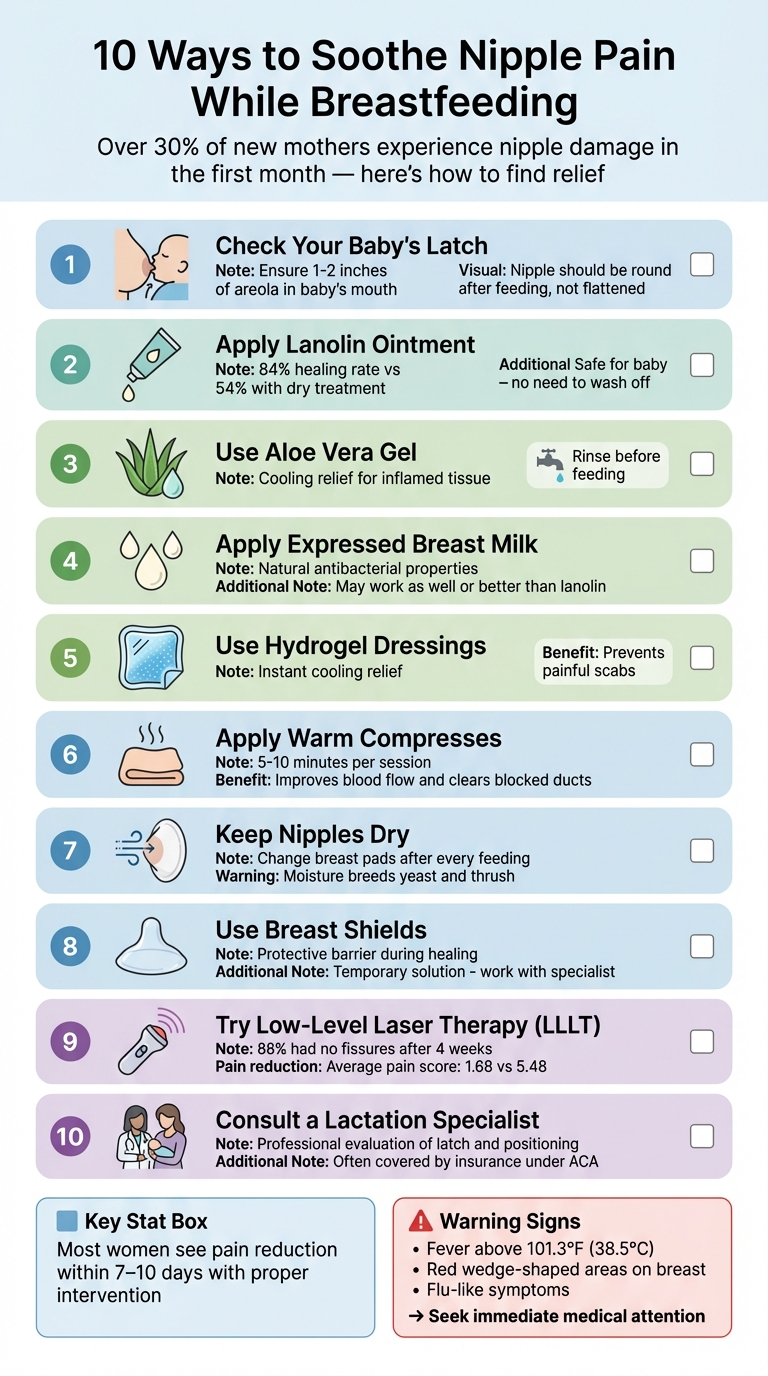
- Check your baby’s latch: A deep, proper latch prevents soreness and ensures effective feeding.
- Use lanolin ointment: Safe for babies and great for moisturizing and healing cracked skin.
- Apply aloe vera gel: Soothes inflammation but must be rinsed off before feeding.
- Express breast milk: Natural antibacterial properties help heal and protect sensitive skin.
- Try hydrogel dressings: Cooling relief and a moist healing environment for damaged nipples.
- Apply warm compresses: Reduces pain, improves blood flow, and helps clear blocked ducts.
- Keep nipples dry: Air-dry after feeding and change damp breast pads often to prevent infections.
- Use breast shields: Protects sore nipples while allowing you to continue breastfeeding.
- Consider low-level laser therapy (LLLT): Non-invasive light treatment to reduce pain and speed up healing.
- Consult a lactation specialist: Get expert help for persistent pain or underlying issues like tongue-tie or poor latch.
Addressing nipple pain early is key to maintaining a comfortable breastfeeding experience. Simple adjustments and treatments can make a big difference, but professional support is available if needed.
10 Effective Methods to Relieve Breastfeeding Nipple Pain
How to Relieve Nipple Pain
sbb-itb-9ce2258
1. Check Your Baby's Latch
Preventing nipple pain starts with ensuring your baby latches correctly. A shallow latch - where your baby only grasps the tip of the nipple - can lead to soreness, cracking, and even bleeding. This happens because the nipple gets pinched against the hard palate instead of being cushioned by the soft palate further back in the mouth.
The U.S. Department of Health & Human Services explains the issue clearly:
"A shallow latch happens when your baby does not have enough of your breast in his/her mouth or is too close to the end of your nipple."
A proper latch involves your baby's mouth opening wide - like a big yawn - and covering about 1 to 2 inches of the areola, with more of the lower portion of the areola drawn in. Their chin should press against your breast, lips flanged outward (not tucked in), and their tongue cupped under the breast. After feeding, your nipple should appear round and slightly elongated, not flattened, creased, or pale.
To encourage a deep latch, try these steps:
- Gently tickle your baby's upper lip with your nipple to prompt a wide yawn.
- Aim your nipple toward your baby's nose rather than the center of their mouth.
- Position your baby so their body faces yours completely (tummy-to-tummy).
If the latch feels painful, don't pull your baby off directly. Instead, insert a clean finger into the corner of their mouth to break the suction before trying again.
If pain persists, there could be an underlying issue, such as tongue-tie, which restricts tongue movement and interferes with a deep latch. In such cases, consult a healthcare provider or lactation specialist to evaluate and address the problem. A proper latch is key to relieving nipple pain, so resolving any challenges early is crucial.
2. Apply Lanolin Ointment
Lanolin, a medical-grade moisturizer made from sheep's wool, is a go-to solution for soothing cracked or sore nipples. One of its standout features? It's completely safe for babies to ingest. That means there's no need to wash it off before breastfeeding, making it a super convenient option for regular nipple care.
What makes lanolin even more effective is its ability to promote moist wound healing. By preventing the skin from drying out and forming scabs that could crack during the next feeding, it helps speed up recovery. Studies show that moist wound healing achieves an 84% healing rate compared to just 54% with dry gauze. Sarah Schooler, MSN, RN, IBCLC from Thrive Lactation Center, emphasizes:
"Lanolin is safe for babies and very effective in soothing and moisturizing sore nipples."
For the best results, apply lanolin right after breastfeeding. Use a small, pea-sized amount to gently cover the nipple and areola. Some lactation experts also suggest expressing a few drops of breast milk, letting it air dry, and then applying lanolin to lock in the milk's natural antibacterial benefits.
However, if you're allergic or sensitive to wool, lanolin might not be the best choice - it could cause irritation. In such cases, you can switch to lanolin-free nipple balms made with plant-based ingredients. This approach is just one of many ways to make breastfeeding a more comfortable and manageable experience.
3. Use Aloe Vera Gel
Aloe vera gel can help soothe sore or damaged nipple skin by providing a cooling sensation and promoting a moist environment that supports healing. Studies have shown that gel dressings significantly improve epithelial healing rates - 84% compared to 54% with gauze.
The gel’s high water content delivers an immediate cooling effect, offering relief to inflamed or tender areas. Lactation consultant Eliza Claire, IBCLC, highlights this benefit:
"They provide a cooling effect due to high water content, ideal for soothing inflamed tissue".
To get the most out of aloe vera gel, proper application is crucial.
After breastfeeding, clean the nipple gently with plain water before applying a small amount of aloe vera gel. It’s important to rinse off the gel completely before the next feeding, as aloe vera is not safe for infants to ingest.
When choosing a product, look for aloe vera gels that are free from alcohol, fragrances, and astringents to avoid irritating sensitive skin. Always use products specifically labeled as safe for breastfeeding mothers.
If you notice symptoms of thrush - such as bright pink, itchy, or burning nipples - skip aloe vera. Since yeast thrives in moist environments, using a moisture-retentive treatment could worsen the condition.
4. Apply Expressed Breast Milk
Breast milk isn't just for feeding - it can also help soothe sore nipples. It contains natural antibacterial and healing properties that help repair tissue and protect cracked or sensitive skin.
Studies back this up. One clinical trial found that women who used expressed breast milk experienced less nipple pain within four to five days compared to those using lanolin. Some research even suggests that applying breast milk directly to sore nipples may speed up the healing process. These findings align with expert advice.
Lactation consultant Eliza Claire, IBCLC and Founder of Tender Loving Milk, highlights this benefit:
"A few drops provide a protective barrier before applying a pad. Some research indicates breast milk can work as well or better than lanolin."
To use this remedy, express a few drops of milk after feeding or pumping and gently massage it onto your nipples and areola. Allow your nipples to air dry for a few minutes before covering them. This step is important because trapped moisture can lead to infections. If you're using breast pads, make sure to replace them whenever they get damp to keep the area dry and promote healing.
However, if you suspect thrush, avoid using breast milk as it contains sugars that could encourage yeast growth. Watch for signs of thrush, such as bright pink, itchy, or painful nipples. If these symptoms occur, keep the area dry and consult a healthcare professional.
5. Use Hydrogel Dressings
Hydrogel dressings offer a practical way to manage nipple pain. These dressings provide cooling relief and protect sore nipples by maintaining a moist healing environment. Research shows they can speed up healing more effectively than standard gauze.
"The chilled pad delivers instant cooling relief and eases pain."
One of their key benefits is preventing scabs from forming, which can spare you the discomfort of scabs being pulled off during feedings. They also act as a barrier, reducing chafing from bra fabric, especially when the skin is cracked or bleeding. Popular brands include Medela, Lansinoh, and Tender Loving Milk.
To get the most out of hydrogel dressings, follow these tips:
- Apply the pads right after nursing and remove them before the next feeding.
- Refrigerate the pads for an extra cooling effect.
- Choose lanolin-free and odorless pads if you have sensitive skin.
However, there are a couple of precautions to keep in mind. Avoid using hydrogel dressings if you suspect thrush, as the moist environment can promote yeast growth. Also, skip combining them with lanolin ointment, as the ointment may prevent the pads from sticking properly to your skin.
6. Apply Warm Compresses
Warm compresses can be a helpful addition to topical ointments and dressings when dealing with nipple pain. Applying gentle heat not only soothes discomfort but also improves blood flow, which can speed up skin recovery. This method works well alongside other treatments to ease pain and promote healing.
"Applying a warm compress to the nipples can help reduce pain and promote healing." - Yoshinori Abe, MD
Warm compresses are particularly effective for addressing milk blebs - those small white or yellow blisters caused by blocked nipple pores. The heat softens the area, making it easier to clear the blockage during feeding. If you're experiencing engorgement, using a warm compress before nursing can help stimulate milk flow and relieve pressure.
Here’s how to use a warm compress: soak a clean cloth in warm water, wring it out, and apply it to the affected area for 5–10 minutes. To avoid mess, lean over a sink while applying the compress. For added relief, consider a warm Epsom salt soak. Always use a fresh cloth to minimize the risk of bacterial exposure. If you experience sharp pain or swelling, you can alternate with cold compresses between feedings.
Warm compresses are most effective for easing engorgement and clearing blocked pores. However, if you notice redness, unusual warmth, or develop a fever, contact your healthcare provider immediately, as these could be signs of mastitis.
7. Keep Nipples Dry and Air Them Out
Wet nipples from leaking milk or damp pads can encourage yeast growth and lead to thrush. Keeping your nipples dry between feedings helps your skin recover from the constant friction of nursing.
"Moist bras and nipples are a breeding ground for yeast." - Healthline
After nursing, take a few minutes to let your nipples air-dry or gently pat them with a soft cloth. If you're in a private space at home, going topless for a short time can give your skin the chance to breathe and heal.
Make it a habit to change your breast pads often - ideally after every feeding or as soon as they feel damp. Opt for non-plastic, absorbent pads and stick to cotton bras to allow better airflow. Excess moisture can lead to irritation and even cause the skin to crack or bleed, which can be painful and make nursing more challenging.
"After feeding, if you can let some air reach the nipple for a minute (in a safe and private space), it helps skin rest." - Eliza Claire, IBCLC and Founder of Tender Loving Milk
You can also wear breast shells under your bra to reduce friction and improve airflow. This simple routine helps protect your nipples and works well alongside other soothing strategies.
8. Use Breast Shields
Breast shields are thin, flexible silicone covers designed to fit over your nipple during breastfeeding. They act as a protective barrier, giving cracked or bleeding nipples a chance to heal while still allowing you to nurse.
"If you have pain while nursing, these shields can provide a much-needed barrier between your nipple and your baby's mouth." - Healthline
Beyond offering protection, breast shields can also help improve your baby's latch. Their firmer shape encourages a deeper latch, which can be particularly helpful if your baby has been struggling with a shallow one. The shield’s extended tip touches the roof of your baby’s mouth, stimulating their sucking reflex. Before using one for the first time, make sure to sterilize it by boiling it in water for 15 minutes.
Proper sizing is crucial for effective use. Your nipple should fit comfortably within the shield’s cone. If it touches the top, the shield is too small; if your baby seems to gag, it’s likely too large. To help the shield stay in place, try warming it under water or applying a small amount of nipple cream. You can also use the "inside-out" trick - flip the rim halfway to help draw your nipple deeper into the cone.
Breast shields are meant to be a temporary solution. Prolonged use may affect your milk supply, so it’s a good idea to work with a lactation specialist to address any underlying breastfeeding issues and plan for weaning off the shield. To ensure your baby is getting enough milk while using a shield, monitor their output - at least six wet diapers a day is a good sign. After each use, wash the shield with hot, soapy water and let it air dry completely. Used correctly and under guidance, breast shields can support healing while maintaining your breastfeeding journey.
9. Try Low-Level Laser Therapy
Low-level laser therapy (LLLT), also called photobiomodulation, is a non-invasive treatment that uses specific light wavelengths to promote healing and reduce pain. It works by targeting damaged tissue and deep-tissue nerves, and recent research highlights its benefits.
Take, for example, a 2024 study involving 50 breastfeeding mothers. The results showed that 88% of those treated with LLLT had no nipple fissures after four weeks, compared to just 60% of those using anti-inflammatory creams. Pain levels also dropped significantly, with mothers reporting an average pain score of 1.68 on a 10-point scale, compared to 5.48 in the control group. LLLT typically uses red light (660 nm) for surface healing and infrared light (808–904 nm) for deeper tissue relief.
"Photobiomodulation has emerged as a powerful tool for managing nipple pain in early postpartum recovery. This non-invasive therapy not only reduces pain and accelerates healing but also boosts milk production." – Tracy Donegan, Midwife and Lactation Specialist
For lasting results, consistent treatment is key. Sessions are often needed three to five times a week, lasting about 10 to 15 minutes each. A single session is unlikely to provide lasting relief. It's also crucial to consult with an IBCLC (International Board Certified Lactation Consultant) or a healthcare provider trained in LLLT. They can ensure the therapy is part of a broader plan addressing the root cause of your pain, such as poor latch, tongue-tie, or positioning issues.
In some countries, like Austria, LLLT is already integrated into hospital breastfeeding support programs. While the treatment is generally safe, mild side effects like temporary skin redness or tightness may occur. Always consult a professional before starting. For personalized support, consider professional postnatal care to help navigate your recovery.
10. Consult a Lactation Specialist via Nestling
If nipple pain continues despite trying initial remedies, it’s time to seek professional help. Ongoing discomfort often indicates that adjustments are necessary, and a skilled lactation consultant can help uncover and address the underlying issue.
Nestling provides access to experienced lactation specialists with certifications such as International Board Certified Lactation Consultant (IBCLC) or Certified Lactation Counselor (CLC). During a session, these professionals will observe a full feeding to evaluate your baby’s latch and your positioning. They’ll also check your baby’s mouth for issues like tongue-tie and assess any other factors that might be affecting the latch. This thorough evaluation helps identify lingering problems that other methods may not have resolved.
"Pain is a sign that something needs adjusting. Continuing the same trauma just delays healing." – Eliza Claire, IBCLC
For parents who pump, the consultant can ensure your equipment is working for you. They’ll check the flange size and suction settings to confirm everything is properly fitted. If your nipple rubs against the pump tunnel or too much areola is pulled into the shield, it’s likely a sign of an improper fit. They can also identify infections like thrush - which might cause itching, burning, or flaky skin - or mastitis, and refer you to a doctor if necessary.
Follow-up consultations can provide personalized advice, such as trying a laid-back nursing position for a deeper latch, using safe suction-release techniques, or managing milk blebs and engorgement effectively. With Nestling’s flexible booking options and trusted support, you can move past the pain and establish a more comfortable, sustainable breastfeeding experience.
Conclusion
Nipple pain doesn't have to disrupt your breastfeeding journey. Studies reveal that over 30% of new mothers experience nipple damage within the first month postpartum. Thankfully, simple steps like improving your baby’s latch or using lanolin or hydrogel dressings can offer relief. Most women notice a reduction in pain within 7–10 days when proper interventions are applied.
Pain is your body’s way of signaling that something needs attention. A shallow latch, for instance, is a common cause of discomfort and should be corrected promptly. Addressing these issues early can prevent further complications like cracks, bleeding, or infections such as mastitis, which can jeopardize your milk supply. Interestingly, trying to "rest" your nipples by shortening feeds can have the opposite effect, leading to engorgement and reduced milk production.
"Keeping breastfeeds short to 'rest' your nipples will not ease nipple pain and could affect your milk supply." – NHS
If you’ve tried various remedies but still struggle with persistent pain, it’s a good idea to seek professional help. Many insurance plans, under the Affordable Care Act, fully cover lactation support services. Be alert for warning signs like a fever above 101.3°F (38.5°C), red wedge-shaped areas on your breast, or flu-like symptoms, as these may indicate mastitis and require immediate medical attention.
Acting early to address nipple pain not only safeguards your physical comfort but also helps maintain your confidence and emotional well-being during this important time. Whether through at-home treatments or expert guidance, you can overcome these challenges and establish a comfortable, rewarding breastfeeding routine for both you and your baby.
FAQs
How do I know if nipple pain is normal or a sign of an infection?
Breastfeeding can sometimes cause nipple pain, especially in the early days as your body adapts. This discomfort is often temporary and may improve with proper latching and technique. However, if you experience cracking, bleeding, or signs of infection, it could signal a more serious issue. Be alert for symptoms like worsening pain, redness, or swelling, and reach out to a healthcare provider if these occur.
Should I keep breastfeeding if my nipples are cracked or bleeding?
If you’re dealing with cracked or bleeding nipples, it’s usually advised to keep breastfeeding while working on the issue. Reach out to a lactation consultant, midwife, or breastfeeding specialist to evaluate your baby’s latch and positioning. Getting the right guidance can ease discomfort and stop further damage. Breastfeeding during this time might even support healing and help you stick to your routine, but addressing the underlying cause is key to recovery.
When should I see a lactation consultant for nipple pain?
If nipple pain continues even after trying different remedies, or if you experience problems like a poor latch, cracking, blistering, or bleeding, it might be time to consult a lactation consultant. While mild soreness is normal in the early days of breastfeeding, severe or persistent pain could signal an underlying issue. A lactation consultant can guide you in improving latching techniques and addressing any problems to avoid further complications. Don’t wait to seek support if the pain doesn’t improve or gets worse.









 Sign up with Google
 Sign up with Facebook