
Baby Language Milestones: Birth to 12 Months
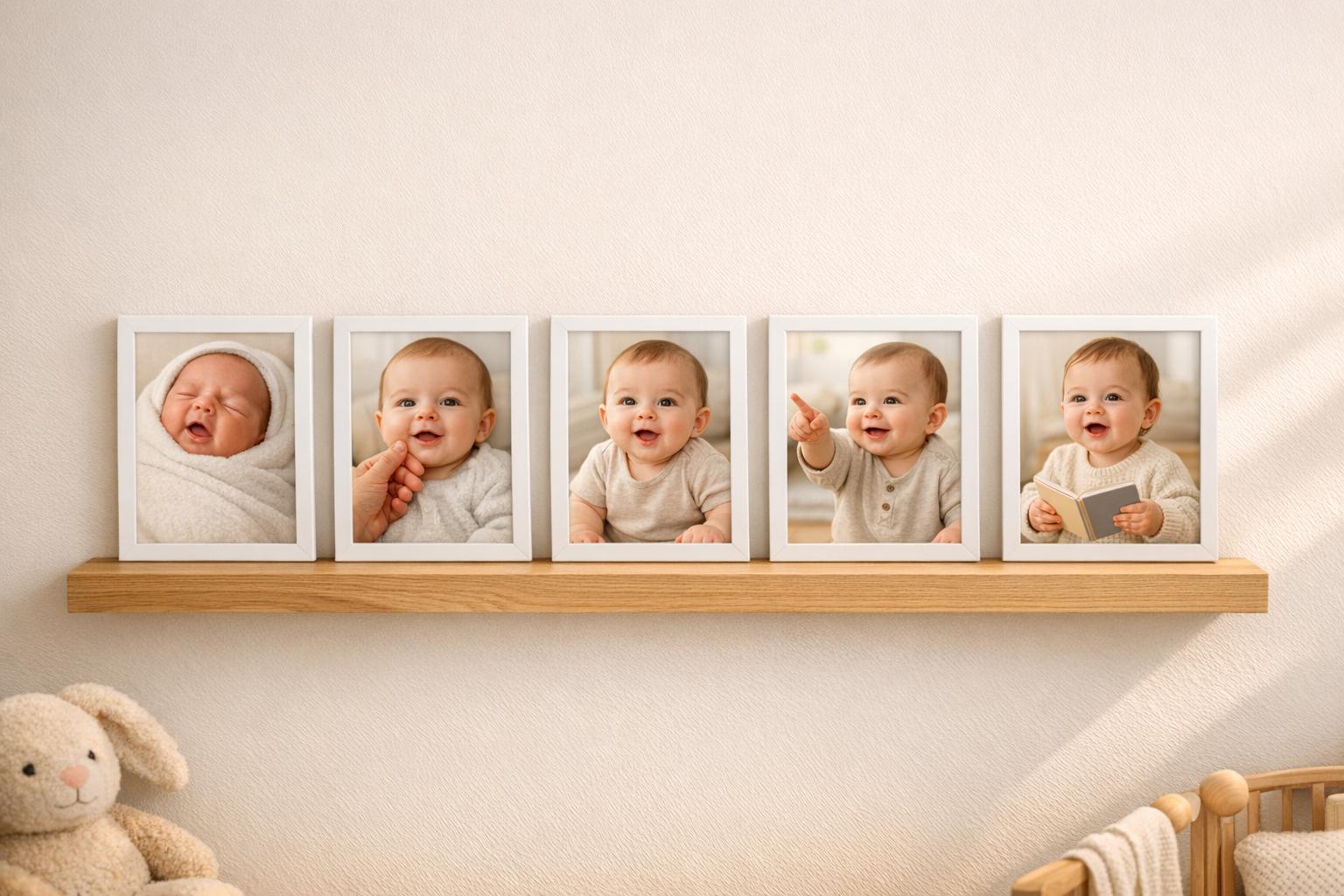
Baby Language Milestones: Birth to 12 Months
Babies begin their language journey from birth, developing the ability to understand and express themselves over time. This process is split into receptive language (understanding sounds, words, and gestures) and expressive language (using sounds, gestures, and words to communicate). Here's a quick breakdown of key milestones by age:
- Birth to 3 Months: Babies recognize familiar voices, use crying to communicate, and begin cooing and smiling socially.
- 4 to 6 Months: Babbling starts, with sounds like "ma" or "ba", and babies respond to tone and sound-making toys.
- 7 to 9 Months: Babbling becomes more intentional, with repetitive sounds like "mamama", and babies understand simple words or phrases.
- 10 to 12 Months: First words appear, gestures like waving develop, and babies combine sounds with actions to communicate.
Every child develops at their own pace, and creating a language-rich environment - through talking, reading, singing, and interactive play - can support their growth. If milestones are missed or skills regress, consult a pediatrician or specialist early.
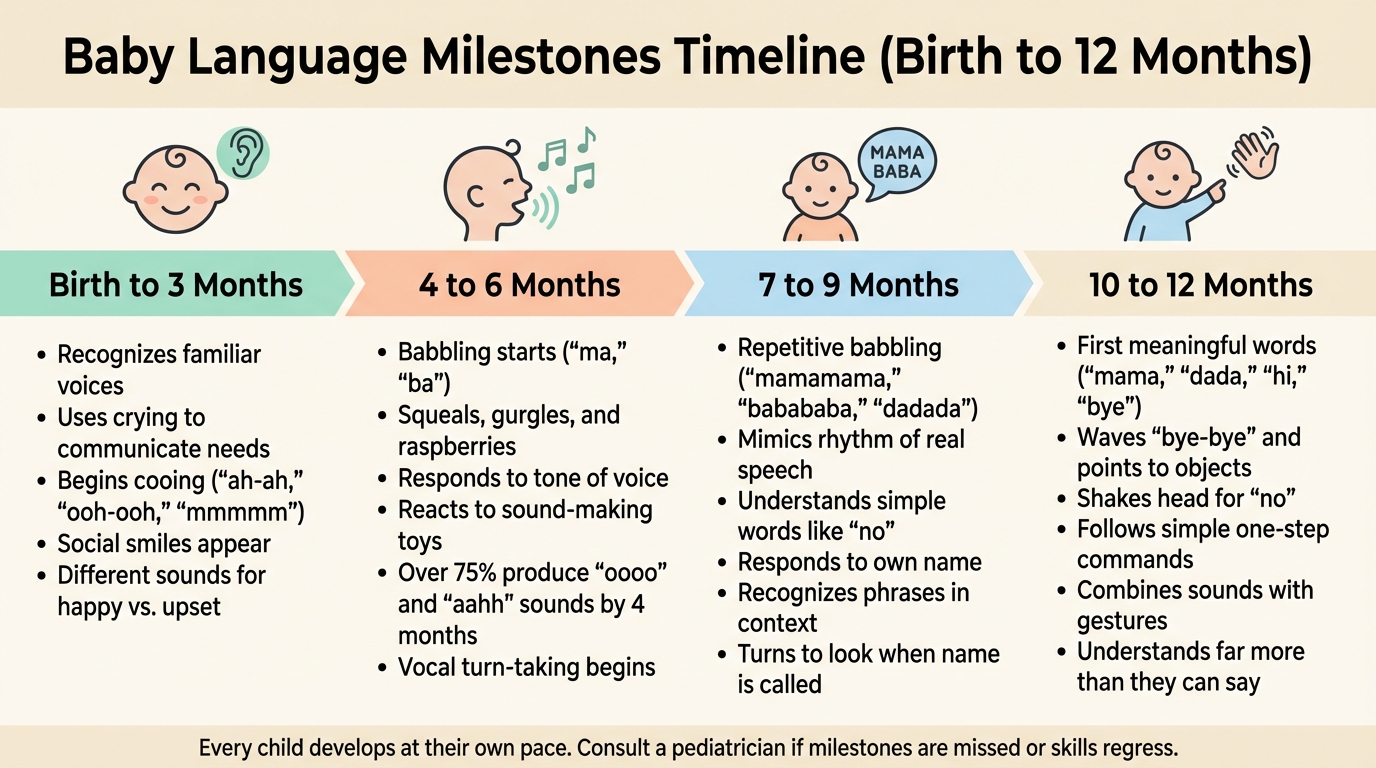
Baby Language Development Milestones from Birth to 12 Months
Baby Speech Milestones: First Year Language Skills and Tips for Parents
sbb-itb-9ce2258
Birth to 3 Months: Early Communication
The first three months of a baby’s life are all about building connections. Even from birth, your newborn is equipped with basic communication skills, often supported by professional newborn care, that start to blossom as they interact with the world.
Recognizing Familiar Voices
Your baby begins recognizing voices even before they’re born. During the prenatal stage, they develop receptive language skills - the ability to process and understand sounds and voices. After birth, you’ll notice your baby reacting to familiar voices in subtle but meaningful ways. They might turn their head, become still and alert, smile, or wave their arms and legs with excitement. These responses show that your newborn is starting to connect certain sounds with feelings of comfort and security. Alongside recognizing voices, crying becomes their main way of communicating needs.
Crying as Communication
In these early weeks, crying is your newborn’s go-to method for expressing hunger, discomfort, or overstimulation. Crying tends to peak around the 6-week mark and then gradually lessens. By the time your baby is 3 months old, you’ll likely notice a significant decrease in crying. Some babies, however, may experience colic - defined as crying for more than 3 hours a day, at least 3 days a week, for 3 weeks or more. While colic can be challenging, most infants outgrow it by the time they reach 3 or 4 months. As crying starts to subside, you’ll begin to see the first signs of vocal experimentation and social smiles.
First Smiles and Cooing
During this stage, your baby starts exploring sounds and expressions beyond crying. Between 1 and 3 months, you’ll likely hear their first vowel-like sounds - “ah-ah,” “ooh-ooh,” and “mmmmm” - as they begin to experiment with their voice. Around the same time, social smiles make their debut. These smiles are often a direct response to your voice or facial expressions, signaling the start of interactive communication. By the end of this period, many babies can produce different sounds depending on whether they’re happy or upset. You can encourage this budding communication by mimicking their sounds and pausing to let them “respond.” This simple back-and-forth exchange teaches the basics of conversation, such as pacing, tone, and turn-taking, laying the groundwork for future communication.
4 to 6 Months: Babbling and Interaction
As your baby grows, their early cooing evolves into more varied and interactive sounds. Between 4 and 6 months, they begin experimenting with squeals, gurgles, and babbling, turning communication into a delightful back-and-forth exchange. This stage is all about exploration and connection as your baby starts responding more actively to the world around them.
Babbling and Gurgling
During this phase, your baby begins testing out a wider array of sounds. You’ll hear squeals, gurgles, and even raspberries as they vibrate their lips and tongue. These playful noises are more than just adorable - they reflect the development of muscle control needed for speech. Babbling becomes more complex, combining vowels and consonants into sounds like “ma” and “ba.” By 6 months, many babies engage in vocal turn-taking, mimicking the rhythm of a conversation. In fact, research shows that by 4 months, over 75% of children can produce sounds like “oooo” and “aahh”.
"The cooing stage is important as this is the time when your baby starts to develop control of the muscles needed for talking."
– Great Ormond Street Hospital
To encourage this vocal play, sit face-to-face with your baby so they can watch your mouth movements. Blow raspberries near their face or on their skin to let them feel the vibrations, and imitate their sounds to start a “conversation.” Pausing to let them respond helps establish the give-and-take of communication. These playful interactions set the stage for recognizing tone and sound.
Responding to Tone and Sounds
Around 4 months, your baby starts reacting to sound-making toys and becomes more attuned to tone. They may giggle at silly noises or become upset by a raised voice. Their vocalizations also take on emotional meaning - happy giggles signal joy and a desire for attention, while distinct cries might indicate hunger or discomfort. This sensitivity shows that your baby is beginning to grasp the importance of how something is said, not just what is said.
You can nurture this sensitivity by varying your voice during play, using different pitches and volumes. Babies often respond enthusiastically to high-pitched, soft tones, so don’t be afraid to exaggerate your expressions and voice to keep their attention.
Engaging with Music and Toys
Music and sound-making toys are fantastic tools for encouraging language development. Items like rattles, bells, or sound-producing books can help your baby learn to track and localize noises. For example, you can shake a rattle and move it side-to-side, encouraging your baby to follow the sound. Narrating your daily activities - whether it’s feeding, bathing, or changing - also introduces new vocabulary in a natural way. Using an animated, high-pitched tone during these interactions can further engage your baby and support their developing language skills.
"Hearing is vital to your child's development. It affects how your child speaks, learns, and communicates."
– UMass Memorial Health
One-on-one interactions are especially powerful during this stage. Whether it’s through music, toys, or simple conversation, these moments lay the groundwork for your baby’s communication and learning journey.
7 to 9 Months: Advanced Babbling and Understanding
Between 7 and 9 months, your baby’s language skills take a big leap forward. Babbling becomes more intentional, serving as a way for your baby to express needs and grab your attention. It’s an exciting phase that builds on earlier cooing and simpler sounds, showing clear progress in communication development.
Consonant-Vowel Babbling
By now, your baby is experimenting with long strings of repetitive sounds, often called reduplicated babbling. Think of phrases like "mamamama", "babababa", "dadada", or "gaga" - you’ll probably hear these a lot! These sounds emerge from varied mouth movements and are an essential step in mastering speech mechanics. Around 8 to 9 months, many babies start mimicking the rhythm of real speech, even though they’re not forming actual words yet.
"Rhythm helps your baby learn what different words sound like and identify when one word ends and the next begins."
– Raising Children Network
These vocal experiments are more than just cute - they show your baby is learning to control airflow and vocal cords. Babbling also becomes a way to connect socially, as babies often make more sounds during play or when trying to engage with you. You can encourage this development by copying their sounds, pausing for their "reply", and minimizing distractions like background noise. These small interactions help prepare them for understanding and eventually using words.
Understanding Simple Words
During this stage, your baby’s ability to understand words - known as receptive language - grows rapidly. They start to show comprehension through actions like waving or turning to look when you say their name. Words like "no" or familiar phrases tied to routines also start to make sense to them.
"By six to nine months, your baby will start to recognise the use of certain phrases in context."
– Great Ormond Street Hospital
You can build their vocabulary by narrating your daily activities. For instance, say, "Mommy is brushing your hair" during grooming or "You’re eating carrots" at meals. Pair these words with gestures like waving or clapping to help them connect sounds with meanings. You can even introduce fun associations, like teaching that "a cow says 'moo'".
Building Vocabulary Through Reading
As your baby’s babbling and word comprehension develop, shared reading becomes an excellent way to boost vocabulary. Research shows that reading with your baby as early as 6 months can have lasting benefits. Repeated exposure to words and the rhythm of stories helps them recognize word boundaries.
Choose sturdy board or cloth books with bold, colorful images. Let your baby explore - whether that means focusing on a single picture, flipping pages quickly, or even chewing on the book! Use varied tones and voices for characters to keep them interested, and sit where they can see your facial expressions and mouth movements. Interestingly, nearly half of parents mistakenly believe reading only benefits language development after age 2. But starting early gives your baby a real head start.
10 to 12 Months: First Words and Intentional Communication
As your baby nears their first birthday, you'll start to notice a big shift: playful babbling evolves into purposeful communication. Words and gestures come together to help them express their needs and ideas more clearly.
First Words
By now, words like "mama" or "dada" may no longer be just sounds - they carry real meaning. Many babies at this stage can say one or two meaningful words, such as "hi", "bye", "shoe", or even exclamations like "uh-oh!" Interestingly, while they might only say a handful of words, their ability to understand far exceeds their verbal skills.
"By 12 months, they may have mastered a few words and usually understand far more."
– Kaiser Permanente
To help your baby along, use clear, natural speech instead of "baby talk." The Mayo Clinic advises, "Using adult speech, not baby talk, teaches your baby to imitate words correctly." Try narrating your daily activities - simple phrases like "Mommy is brushing your hair" or "You are eating a banana" help connect words with actions. When your baby attempts to say a word, respond with enthusiasm and repeat it to reinforce its meaning. Alongside these first words, gestures play a growing role in communication.
Pointing and Following Simple Commands
At this stage, gestures become a key part of how your baby communicates. They might wave "bye-bye", point to something they want, or shake their head to say "no." These actions show they're learning how gestures can help them express their needs and interact with others.
Your baby may also start to follow simple one-step commands, especially when paired with a gesture. For example, saying "Give it to me" while holding out your hand or "Come here" while motioning toward yourself can help them understand and respond. Interactive games like peek-a-boo or pat-a-cake are great for reinforcing these skills. Encourage your baby to mimic actions like clapping or blowing kisses to further develop their communication abilities.
Combining Sounds with Gestures
By now, your baby’s babbling has a new twist - it's paired with gestures and often mimics the rhythm and tone of real speech. This stage, sometimes called "jargon", bridges the gap between early babbling and actual words. For instance, your baby might point to the refrigerator while babbling in a way that sounds like they’re "telling" you they’re hungry.
You can support this stage by responding to their communication efforts. Name objects during your daily routines, explore picture books together, and praise them when they use sounds or gestures. These small but meaningful interactions encourage your baby to keep experimenting with language and build confidence in their growing communication skills.
Supporting Language Growth: Daily Practices
As your baby moves from early babbling to forming their first intentional words, daily interactions play a key role in nurturing language development. Babies who experience frequent and meaningful language exchanges tend to pick up more words over time. And while the quantity of these interactions matters, their quality is just as important.
Talking, Reading, and Singing
Everyday narration is a simple yet powerful way to build your baby's vocabulary. Talk about what you're doing during routine activities like diaper changes ("Let’s button up your onesie"), preparing meals ("I’m slicing an apple for you"), or strolling outside ("Look at the big blue sky!"). These descriptions help your baby connect words to actions and objects, laying the foundation for language.
Using "parentese" - that sing-song, high-pitched tone with exaggerated expressions - can make a big difference. Research shows that babies exposed to parentese babble more and develop stronger language skills by 14 months compared to those who don’t hear it. Speech-language pathologist Abby Barnes, M.S., CCC-SLP, highlights its importance:
"Research has consistently shown that talking frequently to your baby, and speaking in parentese, sets children up for successful language development".
Reading together is another fantastic way to introduce new words and sentence structures. Even if your baby is more interested in chewing on the book than listening, the exposure to language is invaluable. In fact, reading just one book a day can expose your child to about 1.4 million more words by kindergarten. Follow your baby’s cues - point to pictures, describe what you see, and ask simple questions like, "What’s this?" to keep them engaged.
Singing nursery rhymes with hand motions, like "The Itsy-Bitsy Spider", teaches rhythm, tone, and pitch while also encouraging imitation and muscle coordination. When your baby coos or babbles, respond as though you’re having a real conversation. This back-and-forth interaction helps them learn the natural flow of communication. Reducing digital distractions in your environment also ensures these interactions remain rich and focused.
Limiting Screen Time
To maintain high-quality interactions, it’s important to limit screen exposure. For children under 18 to 24 months, screens (except for interactive video chats) are not recommended. Babies learn language best through responsive exchanges - what experts call "serve and return" interactions. Kathy Hirsh-Pasek, PhD, from Temple University, explains:
"The television does not know, nor does an app know, how to be adaptable... And that adaptability is what matters".
Even background TV can disrupt these exchanges, leading to shorter sentences and less meaningful communication. Similarly, parental phone use during playtime - sometimes called "technoference" - can reduce the frequency and quality of interactions. Dr. Hirsh-Pasek advises parents to "put your phones down".
Instead of relying on screens, try narrating your baby’s actions or keeping a small bag of toys, stickers, or crayons handy for moments when a distraction is needed - like waiting at the doctor’s office. If breaking the habit of phone use feels tough, switching your screen to grayscale can make it less tempting.
Nestling's Personalized Care Services
In addition to these daily practices, professional support can further enhance your baby’s language environment. Establishing consistent routines for sleep, feeding, and play helps babies feel secure, giving them the confidence to explore and practice new communication skills. Nestling’s postpartum doulas and infant care specialists are here to help families create these routines while supporting developmental milestones like language growth.
Nestling’s infant care experts can also guide you in creating language-rich interactions. They’ll show you how to narrate daily routines, respond to your baby’s cues, and build meaningful exchanges throughout the day. Postpartum doulas provide emotional support and assist with light household tasks, giving you more time to focus on bonding with your baby. With flexible options like daytime, overnight, and live-in care, Nestling offers the support you need when you need it. Learn more at https://getnestling.com.
When to Consult a Professional
As your baby grows, keeping an eye on their language development is essential. While every child progresses at their own pace, missing milestones or losing previously acquired skills can signal the need for professional guidance. The CDC puts it plainly:
"You know your child best. Don't wait. If your child is not meeting one or more milestones, has lost skills he or she once had, or you have other concerns, act early."
Acting quickly can help address potential challenges before they become more significant. The first three years are especially important for speech and language development because the brain is growing and changing rapidly during this time.
Signs of Delay to Watch For
Certain behaviors - or the absence of them - can indicate a delay in language development. Here are some key signs to monitor:
- Birth to 3 months: Not reacting to loud sounds, not cooing, or missing pleasure sounds.
- 4 to 6 months: Not turning toward new sounds or failing to make babbling sounds like "ba-ba".
- 7 to 9 months: Not responding to their name, not babbling long strings of sounds like "mamamama", or not using gestures such as raising their arms to be picked up.
- 10 to 12 months: Not waving "bye-bye", pointing to objects, or saying simple words like "mama" or "dada".
If your baby misses these milestones or shows any regression in skills, it’s time to seek professional advice.
Seeking Expert Guidance
Start by discussing your concerns with your pediatrician. They can perform an initial screening and refer you to specialists like speech-language pathologists (SLPs) or audiologists. Since hearing issues can directly impact language development, a hearing test is often part of the evaluation process.
You can also reach out to your state’s early intervention program for a free or low-cost evaluation - no referral is required.
For additional support at home, Nestling’s infant care specialists can assist in creating language-rich routines and identifying developmental milestones. They work alongside your pediatrician’s recommendations to support your baby’s progress. Find out more at https://getnestling.com.
Conclusion
During the first year, your baby progresses from early cries to their first meaningful words. The key to fostering language development doesn’t come from apps or formal lessons - it’s rooted in the everyday moments you share. As ZERO TO THREE puts it, "Early language and literacy skills are learned best through everyday moments with your child - reading books, talking, laughing and playing together".
The first three years are a critical window for developing speech and language skills, as the brain is especially receptive during this time. Simple daily interactions - like narrating your day, responding to your baby’s babbles, and reading together - lay the groundwork for lifelong communication. Babies naturally learn language through their desire to connect with you.
While these milestones highlight the importance of daily engagement, some parents may find themselves needing extra support. Every child develops at their own pace, and milestones are just general guidelines. However, if your baby isn’t meeting expected markers or loses skills they previously had, it’s important to trust your instincts and seek professional advice. As the CDC emphasizes, "You know your child best. Don't wait. If your child is not meeting one or more milestones, has lost skills he or she once had, or you have other concerns, act early."
In addition to your everyday interactions, professional support can enhance your baby’s language development. For parents who feel overwhelmed by milestones, Nestling’s infant care specialists offer personalized guidance to help you create language-rich routines and track progress. Working closely with your pediatrician’s recommendations, our caregivers provide practical advice tailored to your baby’s unique needs. Find out more at https://getnestling.com.
FAQs
When should I worry about a language delay?
If your baby isn’t responding to sounds, hasn’t started babbling, or hasn’t said their first words by about 15 months, it might be a sign of a language delay. Pay attention to any stagnation in their speech development or difficulties with understanding and communication. If you’re concerned, it’s a good idea to reach out to a healthcare professional. They can evaluate your child’s milestones and offer advice on next steps.
How can I tell if my baby understands me?
You can figure out if your baby understands you by watching for certain behaviors. For example, do they respond when you say their name? Can they follow simple commands like "come here"? Do they turn toward sounds or objects when you talk about them? These milestones usually show up between 6 and 12 months of age. Keep an eye on these cues as your baby develops to get a sense of how much they’re picking up.
What are the best daily ways to boost speech?
To help your baby develop their speech, make communication a natural part of your day. Respond to their coos and babbles, maintain eye contact, and talk to them during everyday activities like feeding, dressing, or playing. Highlight objects around them, describe what you're doing, and use gestures to reinforce words. Reading books together is another great way to introduce new sounds and words.
You can also sing to your baby, imitate the sounds they make, and engage in back-and-forth "conversations" to encourage their attempts at communication. The key is to interact with them consistently and respond to their efforts, creating a supportive environment for building language skills.

 Sign up with Google
 Sign up with Facebook