
How to Start Postpartum Strength Training at Home
How to Start Postpartum Strength Training at Home
Postpartum strength training is about rebuilding your body after childbirth - not rushing to "bounce back." It helps strengthen your core, pelvic floor, and muscles for everyday tasks like carrying your baby or lifting car seats. Here's what you need to know:
- Consult your doctor first: Get medical clearance, especially if you had a C-section or complications.
- Start slow: Focus on gentle exercises like walking, diaphragmatic breathing, and pelvic tilts.
- Safety first: Avoid heavy lifting or high-impact moves early on. Watch for warning signs like pain or increased bleeding.
- Core recovery is key: Begin with exercises like heel slides, dead bugs, and bird dogs to rebuild deep abdominal muscles.
- Progress gradually: Begin with bodyweight exercises, then add resistance as you heal. Aim for 10–20 minute sessions, 2–3 times a week.
Postpartum recovery takes time - listen to your body and focus on steady progress. Remember, this journey is about healing and regaining strength to meet the demands of motherhood.
Postpartum At Home Workout - Beginner Total Body Workout After Pregnancy!
sbb-itb-9ce2258
Getting Medical Clearance and Knowing When to Start
Before diving into strength training postpartum, it's essential to consult your healthcare provider. This step ensures your body is ready to handle the physical demands of exercise. Your provider will assess your incision, check for diastasis recti, evaluate pelvic floor health, and offer tailored advice based on your recovery progress .
"If you had a cesarean birth or complications, ask your ob-gyn when it is safe to begin exercising again." – American College of Obstetricians and Gynecologists (ACOG)
The timeline for starting postpartum exercise depends on the type of delivery. For those who had an uncomplicated vaginal birth, light activities like walking or gentle stretching can often begin within a few days, as long as you feel ready . However, if you had a C-section, the recovery period is longer. The incision usually takes at least six weeks to heal, during which heavy lifting should be avoided . While moderate to vigorous strength training is often cleared at the six-week postpartum checkup, experts suggest waiting at least 12 weeks before resuming heavy lifting or high-impact activities .
During your postpartum checkup, consider asking your provider these key questions:
- Do I have diastasis recti, and are there specific core exercises I should avoid?
- Is my C-section incision or any vaginal tearing healed enough for resistance training?
- Are there signs of pelvic floor dysfunction I should monitor while exercising?
- Can you refer me to a pelvic floor physical therapist for further assessment?
It's important to remember that pregnancy hormones, like relaxin, can continue to affect your joints for months after delivery, making them more prone to instability and increasing the risk of injury during strength training. Dr. Christie Cobb, a board-certified OB/GYN, emphasizes:
"The joint instability from relaxin [a hormone] released in pregnancy does not magically disappear after delivery"
This is why starting slowly and paying close attention to your body's signals is so important - even if you were very active before or during pregnancy.
Be mindful of warning signs that indicate you need to stop or scale back your exercise routine. These include heavier or redder vaginal bleeding, sharp pain, dizziness, or a sensation of pressure or bulging in the pelvic area . Additionally, if your resting heart rate in the morning is more than 10 beats per minute above your usual rate, it could signal overexertion.
Taking these precautions ensures a safer return to fitness, setting the stage for the safety tips and breathing techniques discussed in the next section.
Safety Tips and Breathing Techniques
Postpartum strength training requires a careful approach that prioritizes healing. After all, your body has just undergone an extraordinary experience, and recovery shouldn't be rushed.
Pay close attention to how your body feels during each workout. If you notice vaginal bleeding, sharp abdominal pain, or pelvic discomfort, stop immediately and consult your healthcare provider or seek postnatal care. In these early weeks, proper form is far more important than intensity. Stick to slow, controlled movements instead of attempting heavy weights or high repetitions. Trainer Emily Skye, founder of FIT Post-Pregnancy, advises:
"Any core work at this stage of your recovery needs to be slow and controlled - remember, don't push your limits"
Additionally, make sure your workout space is free from hazards, especially if your baby is nearby. Now, let’s talk about diaphragmatic breathing and how it can support your core recovery.
Diaphragmatic Breathing for Core Recovery
Diaphragmatic breathing is a cornerstone of postpartum core recovery, as it helps engage the deep core muscles, particularly the transverse abdominis. To practice this technique:
- Sit or lie down comfortably.
- Place one hand on your chest and the other on your belly.
- Inhale deeply through your nose, letting your belly rise while keeping your chest and shoulders still.
- Exhale slowly through your mouth, allowing your belly to fall as you gently engage your core.
Brittany Robles, MD, MPH, CPT, and Postpartum Trainer, highlights its benefits:
"Diaphragmatic breathing is another great exercise to teach you how to activate your core muscles as you take deep breaths. It's also one of the best introductory exercises for women with diastasis recti"
Practical Tips for Safer Workouts
A few small adjustments can make your postpartum workouts more comfortable and safe. If you're breastfeeding, try feeding or pumping before exercising to avoid discomfort. Wear a supportive bra and loose-fitting clothes to stay comfortable. Keep a water bottle nearby and take regular sips to stay hydrated throughout your session. These simple steps can help you ease into your fitness routine while prioritizing your well-being.
Warm-Up Routine to Prepare Your Body
Take 5–10 minutes to warm up - it’s a simple way to increase blood flow, loosen tight muscles, and get your core and pelvic floor ready to work.
Start with 2–3 minutes of diaphragmatic breathing. Lie on your back, bend your knees, and focus on deep, steady breaths. Then, move into 10 pelvic tilts: press your lower back into the floor, hold for 5–10 seconds, and release. This helps ease stiffness and activates your transverse abdominals. Follow this with Cat-Cow stretches for about a minute. From a tabletop position, alternate between arching and rounding your spine to improve spinal mobility and circulation.
To address shoulder posture, try scapular wall slides. Stand with your back against a wall and slide your arms in "V" and "W" shapes. Add 10–15 neck and shoulder rolls to release tension.
Wrap up with 3–5 minutes of light walking or marching. Keep the pace easy - enough to hold a conversation comfortably. As Dr. Brittany Robles, MD, MPH, CPT, and Postpartum Trainer, explains:
"Walking is one of the best exercises you could do in the immediate postpartum period, as it will get your blood circulating and your muscles active".
It’s also important to note that the hormone relaxin stays in your system for several months after giving birth, which makes your joints and ligaments more delicate . Avoid deep stretches or pushing your body to its full range of motion during these early weeks. Your warm-up should feel gentle and restorative - not strenuous.
Once your body feels activated, you’ll be ready to move on to core-strengthening exercises.
Core Strengthening Exercises
Once your body is warmed up and your core is activated, it's time to focus on exercises that specifically rebuild your deep abdominal muscles.
Postpartum training prioritizes the transverse abdominis - those deep abdominal muscles that stabilize your spine, protect your back, and assist in closing diastasis recti. While the abdominal gap often closes by around 8 weeks postpartum, targeted exercises can speed up the healing process.
Breathing matters. Exhale during the contraction phase of each movement and inhale as you return to the starting position. This helps manage intra-abdominal pressure and supports your recovery.
Pay attention to warning signs. If you notice "coning" (a bulge or ridge forming along the center of your belly), stop immediately and modify the exercise. Coning indicates that your core isn't ready for that level of intensity. Additionally, stop if you experience pelvic pain or if your lower back begins to arch away from the floor.
The following exercises are gentle yet effective for re-engaging your core. Perform each movement slowly and with control - rushing through them relies on momentum, not muscle strength.
Heel Slides
Lie on your back with your knees bent and feet flat on the floor. Press your lower back firmly into the mat to activate your core. Slowly slide one heel away from your body, extending your leg until it's straight. Exhale as the leg extends, then inhale as you return it to the starting position. This movement focuses on the lower abdominals without requiring a crunch. If your back begins to arch, reduce the range of motion to maintain proper form.
Dead Bug
Postpartum Fitness Coach Anna Carter calls this exercise the "gold standard" for postpartum core recovery because it strengthens the transverse muscles while avoiding direct pressure on the abdomen. Start on your back with arms extended toward the ceiling and knees bent at a 90-degree angle. Slowly lower your right arm overhead while extending your left leg toward the floor. Exhale during the extension and inhale as you return to the starting position, then switch sides. Keep your lower back pressed into the mat the entire time. If maintaining this contact feels difficult, reduce your range of motion.
Bird Dog
Position yourself on all fours, with hands directly under your shoulders and knees under your hips. Extend your right arm forward and your left leg back simultaneously, holding the position for 3–5 seconds. Exhale as you extend and inhale as you lower back to the starting position. This exercise improves core stability and balance, but proper form is key: keep your hips level and avoid arching your lower back. If balancing feels too challenging, begin by lifting just one limb at a time and progress as your stability improves.
These foundational moves will help you build strength and stability, setting the stage for the next steps in your postpartum fitness journey.
Lower Body Strengthening Exercises
Now that your core is activated and ready, it's time to focus on building strength in your lower body. This area carries much of the physical workload of motherhood, so strengthening it is a must.
Your legs, glutes, and hips play a critical role in managing everyday tasks. Think about it - just carrying a newborn in a car seat can add 12–15 lbs to your load. Building strength in these areas not only supports these physical demands but also helps restore pelvic stability and improve posture. Trainer Emily Skye highlights the importance of this work:
"Deadlifts are the perfect exercise to strengthen your glutes, quads and hamstrings, which is essential for picking up and carrying your new baby"
Below, we'll walk through two key exercises designed to stabilize your pelvis and build strength where you need it most.
Before starting, remember to exhale and engage your pelvic floor and deep core - imagine zipping up a snug pair of jeans. This technique helps protect your healing body and lowers the risk of postpartum injuries. Pre and Postnatal Exercise Specialist Peri Hughes explains:
"The more we can train our bodies to exhale and engage our deep core through exertion, the more we can help protect our pelvic floor"
Let’s dive into two simple yet effective moves to strengthen your glutes and legs.
Glute Bridges
Start by lying on your back with your knees bent and feet flat on the floor, about hip-width apart. Press through your heels to lift your hips, creating a straight line from your shoulders to your knees. At the top, squeeze your glutes, hold for a few seconds, and then lower back down. Be mindful to keep your stomach flat and avoid arching your lower back. For extra stability, try placing a folded towel between your knees. Aim to complete 2–3 sets of 10–15 reps.
Reverse Lunges
Stand upright with your feet hip-width apart and engage your core. Step one foot back and lower your hips until both knees form 90-degree angles. Ensure your front thigh is parallel to the ground, and your front knee stays directly above your ankle. Push through your front heel and tighten your glutes to return to standing. If balance feels tricky, use a wall or chair for support as you build confidence. Perform 1–3 sets of 8–12 reps per side.
These exercises are straightforward but pack a punch when it comes to building the strength you need for the everyday challenges of motherhood.
Upper Body and Full-Body Strengthening Exercises
Once you've focused on core and lower body strength, it's time to shift attention to your upper body and overall stability. These areas are crucial for managing the physical demands of motherhood.
Your upper body plays a key role in everyday tasks like carrying your baby, lifting a car seat, pushing a stroller, and even nursing. These activities can strain your shoulders and lead to poor posture. Strengthening your arms, shoulders, and chest can help counteract these challenges, making daily responsibilities feel more manageable. Trainer Emily Skye highlights the benefits of this kind of training:
"Strengthening your shoulders will not only support carrying your baby, but keep your posture upright and help to prevent aches and pains that can come with breastfeeding."
The exercises below are designed to improve upper body strength while engaging your core for better overall stability. Start with simpler, modified versions and gradually increase intensity - proper form is more important than pushing yourself too hard during postpartum recovery.
Child's Pose Push-Up
This modified push-up strengthens your chest, shoulders, and triceps while being gentle on your healing core. Begin in a modified plank position on your knees, with your hands under your shoulders. Engage your core and push your hips back toward your heels, moving into a child's pose. From there, press forward into the plank position. Lower your chest toward the floor, keeping your elbows close to your body, and then push back up to the starting position. Perform 2–3 sets of 6–10 reps, focusing on slow, controlled movements.
Side Plank
The side plank is excellent for strengthening your obliques, shoulders, and outer glutes, which help stabilize your pelvis. Lie on your side and prop yourself up on your forearm, ensuring your shoulder is directly above your elbow. Keep your bottom knee bent on the mat for extra support, and extend your top leg. Engage your core and lift your hips off the mat, forming a straight line from your head to your knees. Hold this position briefly, tightening the muscles on your lower side, then lower yourself back down with control. Start by holding for 10–20 seconds, gradually increasing to 30 seconds as your strength improves. Do 2–3 sets on each side.
Sample Beginner Workout Plan
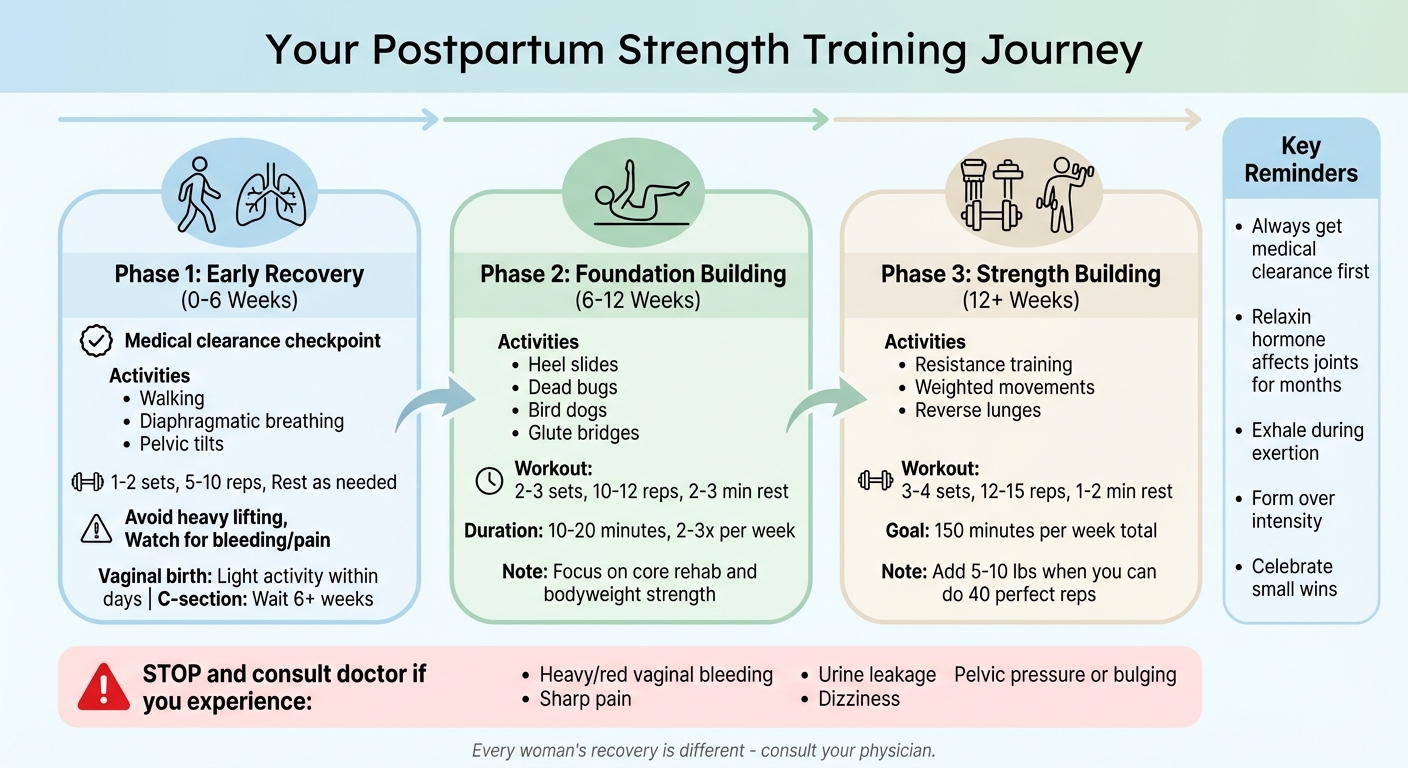
Postpartum Strength Training Recovery Timeline and Progression Guide
This workout plan organizes the exercises we’ve discussed earlier into a structured routine to help you ease back into fitness postpartum. A balanced postpartum workout should include four essential movement patterns: a push, a pull, a knee flexion (like squats), and a hip extension (like bridges). To round it out, add a core-focused exercise for abdominal strength.
The American College of Obstetricians and Gynecologists (ACOG) suggests postpartum women aim for 150 minutes of exercise per week. If that seems daunting at first, start small: try 10–15 minute sessions three times a week to establish a habit. During the first two months, focus on light resistance and higher repetitions to gently rebuild your strength.
Stronger muscles don’t just improve your physical abilities - they also help increase lean body mass and support a healthy metabolism. Aim for a 7/10 intensity level - challenging but still manageable - and always begin with a 5-minute warm-up to raise your body temperature and improve blood flow.
For breastfeeding mothers, exercising after feeding can help minimize discomfort, and staying hydrated during your workout is key . If you experience pain, urinary leakage, or increased vaginal bleeding during any exercise, stop immediately and consult your healthcare provider .
As your recovery progresses, you can gradually increase the intensity of your workouts. Use the table below as a guide to safely transition from early postpartum recovery to more advanced training.
Progression Table for Postpartum Workouts
| Level | Focus | Sets | Reps | Rest |
|---|---|---|---|---|
| Beginner (0–6 Weeks) | Breathing, Pelvic Floor, Walking | 1–2 | 5–10 | As needed |
| Intermediate (6–12 Weeks) | Bodyweight Strength, Core Rehab | 2–3 | 10–12 | 2–3 minutes |
| Advanced (12+ Weeks) | Resistance Training, Weighted Moves | 3–4 | 12–15 | 1–2 minutes |
This progression allows you to build strength at a pace that aligns with your body’s healing process. Always listen to your body and adjust as needed for a safe and effective recovery.
Common Mistakes to Avoid and Tips for Progression
Building your postpartum strength requires patience and avoiding common missteps.
Jumping into intense workouts too soon can lead to injuries and slow down recovery. The pressure to regain fitness quickly might tempt you, but your body needs time to heal. Experts recommend waiting at least 16 weeks to allow tissues to strengthen, with full recovery sometimes taking up to six months. Following these timelines helps set a solid foundation for safe recovery.
Skipping essential core exercises is another frequent mistake. Many new moms bypass deep core work - targeting the diaphragm, transverse abdominis, and pelvic floor - and go straight to crunches or cardio. However, as Roselyn Reilly, Facility Leader and Trainer at Fit Body Boot Camp, emphasizes:
"The most important thing in the postpartum period is getting core strength back"
Without rebuilding this core strength, you're essentially working on an unstable base.
Ignoring warning signs can also sideline your progress. Symptoms like urine leakage, sharp pain, or increased vaginal bleeding during workouts signal that you need to stop and consult your healthcare provider. Pay attention to vaginal discharge (lochia) as well - if it becomes pinker, flows more heavily, or restarts after exercise, it's a sign to slow down and contact your doctor.
Neglecting proper form when fatigued is a recipe for injury. As you tire, your technique can falter - your back may arch during core exercises, hips might roll during leg lifts, or knees could drift too far forward in lunges. Taylor Price, P.T., D.P.T. at UT Southwestern Medical Center, advises:
"If at any point you are unable to maintain proper form, move back to the previous weight and try increasing repetitions"
Mastering form with bodyweight exercises before adding resistance is key to avoiding strain.
To progress safely, follow these tips alongside your foundational exercises. Use the 40-rep rule: once you can perform 40 reps with perfect form, increase the weight by 5–10 lbs. Test your readiness by balancing on one leg for 10 seconds, hopping on one leg 10 times pain-free, and jogging in place for one minute without urine leakage. Sleep is also crucial - less than 6.8 hours a night raises your risk of exercise-related injuries, so prioritize rest. Finally, always exhale during the hardest part of each movement to reduce pelvic floor pressure and lower your injury risk.
Conclusion
Recovering postpartum is a step-by-step process, and strength training plays a key role in helping your body heal. After all, your body has been through some major changes. Ligaments can stay delicate for months, and relaxin may remain in your system for up to a year. It’s important to let your core and pelvic floor rebuild their connection at their own pace.
As Dr. Lindsey Longerot, OB-GYN, wisely points out:
"The most important thing to remember is that every woman's recovery is different and that she should talk with her physician before starting any exercise program."
Safety should always come first. Make sure you get medical clearance before starting, focus on breathing and proper form, and stop immediately if you notice pain or bleeding. Start small with gentle core exercises and aim for consistency - short, 10–20 minute sessions can be more effective than jumping into intense workouts. This gradual approach, from reconnecting your core to slowly building strength, lays a solid foundation for long-term fitness.
Take time to celebrate the little wins, whether it’s moving for five minutes, sleeping better, or simply feeling stronger. Pay attention to how your body feels instead of focusing only on how it looks.
For extra support, check out Nestling to connect with experienced postpartum doulas and lactation consultants. They can provide personalized care, emotional guidance, and recovery plans tailored to your needs.
Every bit of movement you do adds to your resilience, helping you thrive in the journey of motherhood.
FAQs
What’s the best way to safely begin and advance postpartum strength training at home?
To ease into postpartum strength training at home, take a gradual approach that focuses on healing and rebuilding your strength. Start with gentle exercises like diaphragmatic breathing, pelvic floor activations, and light stretches. These movements help you reconnect with your body and improve posture - key priorities during the early recovery weeks.
Once your healthcare provider gives you the green light - usually around 6 to 12 weeks postpartum - you can begin incorporating more structured exercises. Bodyweight movements like squats, glute bridges, and modified planks are great starting points. Pay close attention to your form, and avoid anything that causes pain or discomfort. Over time, you can gradually increase the intensity and volume of your workouts, but always listen to your body and allow recovery to remain your top priority.
For extra guidance, services like Nestling can connect you with postpartum care experts. They can provide personalized support to help you navigate your recovery and create a plan that suits your needs.
When should I stop postpartum workouts and reach out to a doctor?
If you experience any of the following during exercise, it's crucial to stop and consult a doctor: abdominal separation (diastasis recti), urinary leakage, vaginal pressure or bulging (possible prolapse), pelvic pain, or discomfort caused by tight scar tissue. These could be signs that your body needs additional healing time or professional care.
Pay attention to how your body feels, and don't hesitate to reach out for medical advice if something doesn't feel right. Your health and recovery should always take priority!
How does diaphragmatic breathing help with postpartum core recovery?
Diaphragmatic breathing is an essential technique for rebuilding core strength after childbirth. It specifically targets the deep abdominal muscles, like the transverse abdominis, which are crucial for maintaining core stability. This breathing method also helps re-establish the connection between the core and pelvic floor muscles, aiding in recovery and healing.
One of its key benefits is reducing intra-abdominal pressure. By doing so, diaphragmatic breathing minimizes strain on the body during exercises, making it an ideal, gentle approach for regaining strength. For those dealing with diastasis recti, this technique is particularly beneficial, as it focuses on controlled muscle activation without overloading the core.
Beyond physical recovery, diaphragmatic breathing promotes relaxation and helps lower stress levels. This dual benefit supports not only the healing process but also emotional well-being during the postpartum phase.





 Sign up with Google
 Sign up with Facebook