
5 Steps to Create a Maternity Leave Plan with Your Employer

5 Steps to Create a Maternity Leave Plan with Your Employer
Planning your maternity leave doesn’t have to be overwhelming. The key is early preparation and clear communication with your employer. Here’s how you can create a plan that ensures your job security, reduces stress, and keeps your team on track while you’re away:
- Understand Your Rights: Familiarize yourself with federal laws like FMLA, state-specific paid leave programs, and your company’s policies. Check eligibility requirements and income replacement options.
- Talk to Your Employer Early: Share your plans with your manager and HR by the end of your first trimester. Discuss leave dates, financial arrangements, and task coverage.
- Prepare a Transition Plan: Document your responsibilities, train colleagues, and set up tools to keep workflows steady during your absence.
- Plan Finances: Assess income during leave, explore benefits like short-term disability or state programs, and budget for baby-related expenses.
- Set Boundaries for Leave and Return: Decide how connected you’ll be during leave and plan a gradual return to ease back into work.
Starting this process 3–4 months before your leave ensures a smoother transition for both you and your workplace. Early planning allows you to focus on what matters most - your health and your new baby.
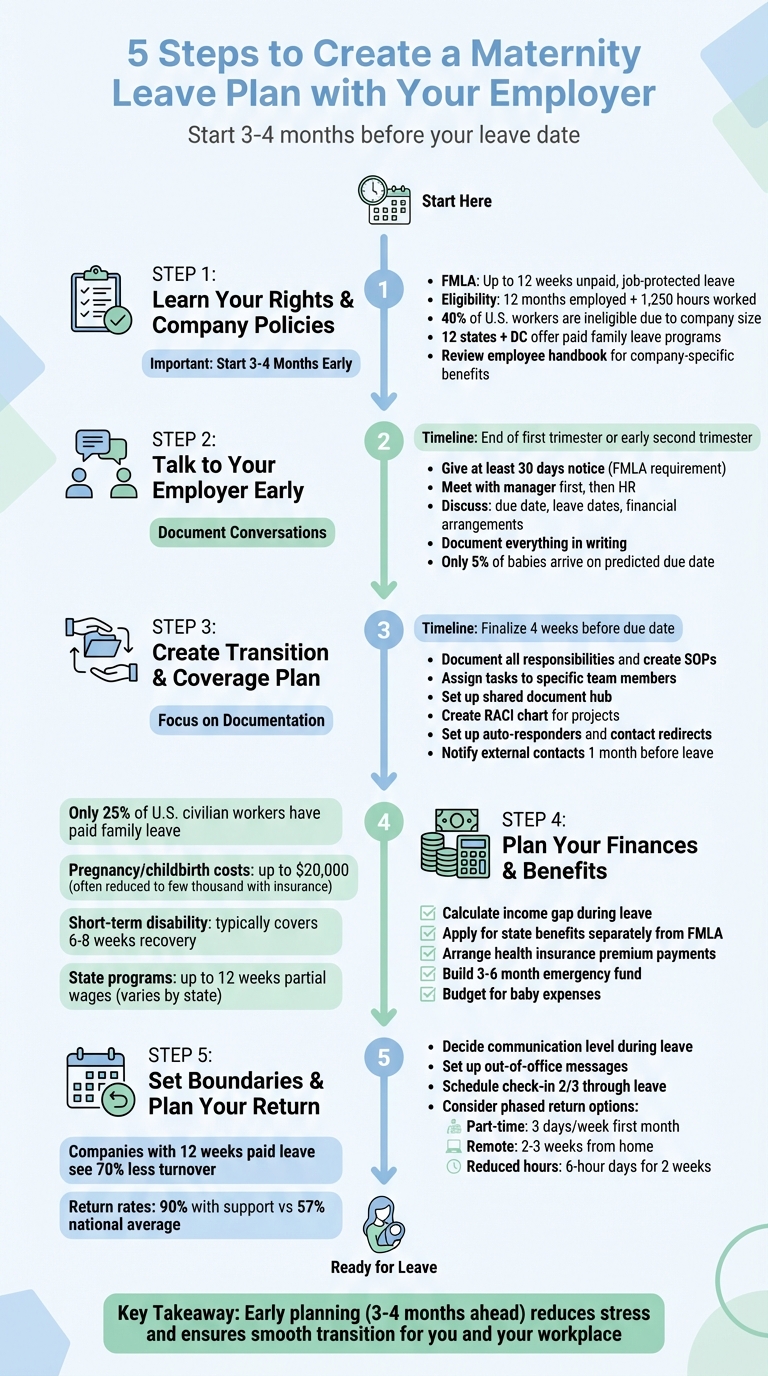
5-Step Maternity Leave Planning Process: Timeline and Checklist
How to Maximize Maternity Leave & Paternity Benefits with MAMAttorney Daphne Delvaux
sbb-itb-9ce2258
Step 1: Learn Your Maternity Leave Rights and Company Policies
Being well-informed is the cornerstone of planning your maternity leave effectively. To start, you’ll need to understand the legal protections you’re entitled to and how your company policies align with them.
Know Your Federal and State Rights
The Family and Medical Leave Act (FMLA) allows eligible employees to take up to 12 weeks of unpaid, job-protected leave within a 12-month period for childbirth and bonding with a newborn. To qualify, you must meet these conditions:
- Have worked for your employer for at least 12 months.
- Completed 1,250 hours of work during the past year.
- Work at a location where the employer has 50 or more employees within a 75-mile radius.
"Mothers and fathers have the same right to take FMLA leave to bond with a newborn child." - U.S. Department of Labor
While FMLA ensures your job is secure, it doesn’t guarantee any income during your leave. This is where state-specific programs can make a difference. As of 2026, 12 states and the District of Columbia offer paid family leave programs, which provide partial wage replacement. For example:
- In California, workers can receive 60% to 70% of their weekly wages for up to 8 weeks through State Disability Insurance.
- Colorado’s FAMLI program, starting in January 2026, provides up to 28 weeks of combined leave for standard situations and Neonatal Care Leave for NICU cases.
Since FMLA doesn’t cover everyone - about 40% of U.S. workers are ineligible due to company size - it’s worth checking your State Labor Department’s website for additional options. Some states, like Illinois, are introducing additional protections. For instance, starting June 1, 2026, Illinois’ NICU Leave Act provides 20 days of unpaid leave for NICU situations, which can be added on top of FMLA leave (rather than overlapping with it) for employees at companies with 50+ workers.
Once you’ve reviewed these rights, it’s time to dive into your company’s policies.
Review Company Policies
Your employee handbook is the best place to start when researching what your company offers beyond federal and state requirements. Some employers provide paid maternity leave as part of their benefits package, though the specifics vary. For example:
- Netflix offers a full year of paid leave.
- Microsoft provides five months of paid leave for birth mothers.
Pay attention to whether your company requires you to use accrued vacation or sick time before accessing additional leave. Some employers allow you to combine different types of leave to extend your time off, while others may require you to exhaust your accrued leave first. Also, check how your benefits - like health insurance, retirement contributions, and performance reviews - are handled during your absence.
Once you’ve reviewed the handbook, prepare to reach out to HR with any lingering questions.
Prepare Questions for HR
Set up a meeting with HR to clarify any points that aren’t fully addressed in your handbook. Here are some key questions to ask:
- Does the company provide paid leave beyond what’s required by law? If so, is it 100% of your salary or a percentage, and for how many weeks?
- Are you required to use PTO before accessing company-paid or unpaid leave?
- How will your leave affect bonuses, annual reviews, or scheduled raises?
It’s also essential to confirm health insurance details. For example, what’s the deadline for adding your baby to your health plan (usually 30 days)? How will premiums be handled during unpaid leave - will you need to pay them directly, or will they be deducted retroactively from your first paycheck after returning?
"Parental leave is not a perk. It is protective health time that safeguards recovery, bonding, feeding, and mental well-being." Many families also consider postpartum doula support to assist with these transitions during the first 40 days. - Motherly
After the meeting, send a follow-up email summarizing your discussion. This ensures that both you and your employer have a clear, written record of what was agreed upon, helping to avoid any misunderstandings later.
Step 2: Talk to Your Employer Early
Once you’ve reviewed your leave policies, it’s time to share the news with your employer. Ideally, aim to do this by the end of your first trimester or early in your second trimester. The Family and Medical Leave Act (FMLA) requires you to give at least 30 days' notice for foreseeable leave, like childbirth. Plus, there’s a practical side to starting early: only 5% of babies arrive on their predicted due date, and about 11% are born prematurely (before 37 weeks). By initiating the conversation early, you allow time to plan ahead, reduce last-minute stress, and explore options like flexible schedules or a phased return. This discussion is key to bridging your rights with practical workplace arrangements.
"Keep in mind that as soon as you tell one person you should assume the cat is out of the bag and your boss will know soon if you haven't told him or her."
– Tiffany Nieslanik, The Mom Project
Schedule a Meeting with HR and Your Manager
Start by setting up formal meetings - one with your direct manager and another with HR. Speak with your manager first to avoid them hearing the news through office chatter, which helps build trust. Before these meetings, prepare an emergency contact plan in case unexpected situations arise.
What to Discuss During the Meeting
When you meet, cover the basics like your due date, your planned last day in the office, and your expected return date. Then, dive into the financial aspects. Confirm whether you’ll use accrued PTO or sick leave, check your eligibility for short-term disability, and clarify how health insurance premiums will be handled during unpaid leave.
It’s also helpful to assign your daily tasks to colleagues and designate a meeting leader for your absence. Create a detailed document that outlines your responsibilities, step-by-step instructions, and key contacts. Plan to share this with your team about four weeks before your due date. Lastly, set clear communication expectations. Decide whether you’ll disconnect entirely or check in periodically to avoid any confusion. Don’t forget to discuss your return-to-work plan, including options for flexible hours, remote work, or easing back into your role gradually.
Document the Agreement
Make sure everything you discuss is documented. A written record ensures clarity and avoids misunderstandings. Within five business days of your leave request, your employer is required to send you an "Eligibility Notice" confirming whether you meet FMLA requirements. Once they have all the necessary details, they’ll issue a "Designation Notice" to confirm your leave is FMLA-protected.
"Your employer must notify you whether the leave will be designated as FMLA leave after your employer has the information necessary to determine if your leave is covered."
– U.S. Department of Labor
Keep copies of all related documents - emails, forms, medical certifications, and insurance paperwork - in both physical and digital formats. Having this paper trail can protect you if any disputes come up later.
Step 3: Create a Transition and Coverage Plan
Planning your handoff ahead of time is essential to keep things running smoothly for you and your team. Aim to finalize your plan at least four weeks before your due date to avoid any last-minute chaos.
"A well-thought-out parental leave plan will not only help minimize workplace disruptions and confusion, it will help you remain focused on you and your growing family - which is what parental leave is for!"
– Holly Pevzner, Staff Writer, Happiest Baby
Document Your Current Responsibilities
Organizing your responsibilities now will make life easier for everyone later. Start by breaking your work down into categories: tasks that need to continue, tasks that can pause, those with deadlines, and any specialized responsibilities. For recurring processes like invoicing or report creation, create clear standard operating procedures (SOPs) with troubleshooting tips for common errors.
Set up a shared document hub on platforms like Google Docs or Dropbox, and include a simple filing guide so your team can quickly find what they need. Don’t forget to compile a directory of key stakeholders, complete with role details. Make sure you document critical system access information and meeting schedules too. These steps will help your team stay on track while you’re away.
Coordinate with Your Team
Dividing responsibilities thoughtfully is key. Assign task-based duties to specific individuals and separate high-level projects for clarity. Keep core business activities within the team, but for less critical tasks, you might consider temporary support. A RACI chart (Responsibility Assignment Matrix) can help define roles - who's responsible, accountable, consulted, and informed - for each project.
Set up clear escalation paths so your team knows who can make decisions in your absence. If you have a backup, let them shadow you on complex tasks to identify any knowledge gaps. Gradually reduce your workload 1–2 weeks before your leave to test the coverage plan and address any issues. If you manage people, this is also the time to transition your direct reports to an interim manager. These steps will ensure a seamless handoff as your leave approaches.
Set Up Tools and Processes
Prepare your team with the right tools and processes before you go. Record training videos and develop SOPs for recurring tasks. Create a status report summarizing all active projects and include decision trees with "if-then" scenarios to guide your team through common situations without needing your input.
Automate as much as possible - set up an out-of-office email auto-responder, update your voicemail, and configure your Slack status to point inquiries to your designated backup.
"Be upfront about what role you want to play, if any, while on maternity leave so you can help quell those 'emergency' calls."
– Northwestern Mutual
A month before your leave, send a formal email to external contacts introducing their temporary point of contact and providing your absence and return dates. Before you leave, block time on your return calendar for personal tasks (like pumping) and onboarding meetings to ease back into your role.
This comprehensive plan lays the groundwork for the next step: organizing your finances and benefits.
Step 4: Plan Your Finances and Benefits
Getting your finances in order is crucial for a smoother maternity leave experience. Start by calculating your expected income during this time, combining employer-paid leave, state-funded programs, short-term disability benefits, and any accrued PTO or sick days. Subtract this total from your usual take-home pay to identify any income gap. Since only about 25% of U.S. civilian workers have access to paid family leave, careful financial planning becomes even more important if your employer doesn’t offer this benefit.
"Fewer than a quarter of civilian workers have access to paid family leave... If you don't have paid family leave, that means you may need to do a little more planning to ensure you're able to make ends meet after your baby is born."
– Andrew Weber, Senior Director of Planning Philosophy, Northwestern Mutual
Assess Paid and Unpaid Leave Options
The federal Family and Medical Leave Act (FMLA) provides up to 12 weeks of unpaid, job-protected leave for childbirth or adoption. While FMLA itself doesn’t provide income, it often overlaps with other benefits, ensuring job security while you receive supplemental pay.
If you have short-term disability coverage, check your policy for details about salary replacement. Typically, these plans cover the recovery period - usually 6 to 8 weeks after childbirth - but may have waiting periods or exclusions for pre-existing conditions. Additionally, state-funded paid family leave programs in states like California, New Jersey, New York, and Washington can provide partial wages for up to 12 weeks, though these benefits require a separate application process from FMLA.
You can also use accrued vacation or sick days to receive pay during your FMLA leave. Even if your leave is unpaid, your employer must continue your group health insurance under the same terms as when you were working. However, you’ll still be responsible for your portion of the premiums, so make arrangements with HR to handle these payments.
Explore Additional Benefits
Look into other programs that can help close financial gaps. If your state offers paid family leave, research the application process and benefit amounts, as these vary by location. For example, Washington State plans to expand job protection for Paid Family and Medical Leave starting January 1, 2026, for employees who have worked at least 180 days with their employer.
Check if your employer offers a Dependent Care FSA, which lets you use pretax dollars to cover childcare costs once you return to work. Federal programs like WIC or SNAP can help low-income families with food expenses. Since health insurance premiums won’t be automatically deducted during unpaid leave, coordinate with HR to either prepay or send payments directly. Keep all agreements in writing and organize HR forms, insurance details, and correspondence in one place for easy reference.
Budget for Leave
Prepare a budget to account for lost income and new expenses. Start by estimating medical out-of-pocket costs. While pregnancy and childbirth expenses can climb to $20,000, insurance often reduces these costs to a few thousand dollars. Review your health insurance plan to estimate expenses for prenatal care, delivery, and postnatal care.
Create a “baby budget” that includes recurring costs like diapers, formula, clothing, and pediatric visits. Research childcare costs early, as long waitlists are common. Build or maintain an emergency fund covering 3 to 6 months of expenses and set up a dedicated savings account with automatic contributions.
To prepare financially, consider cutting back on discretionary spending, like entertainment and travel, before the baby arrives. If you have high-interest debt, consolidating it into a lower-interest personal loan can free up cash for baby-related costs.
Once your financial plan is in place, you’ll be ready to focus on setting boundaries and planning your return to work.
Step 5: Set Boundaries and Plan Your Return
As you prepare for your transition back to work, setting clear boundaries and planning a phased return can make a big difference. Your maternity leave is meant for recovery and bonding with your baby - not juggling work tasks. Establishing these boundaries helps protect your personal time and creates a smoother path for when you're ready to rejoin the workplace.
Establish Communication Boundaries During Leave
Decide early on how connected - or disconnected - you want to be during your leave. Will you stay completely offline, or will you be available for specific, high-priority updates? Set clear expectations about how often, if at all, you’ll check in, and define what qualifies as an urgent matter. You could even create a list of scenarios that warrant your attention and defer all other communication until you're back.
An out-of-office email is a great tool to set the tone. Include your unavailability, your expected return date, and contact information for a colleague who can handle inquiries in your absence. Assigning a trusted point person ensures that only critical updates reach you, helping you focus on your time away.
Once your communication plan is in place, you can shift attention to organizing your return.
Plan a Gradual Return to Work
A phased return can help ease you back into your professional routine. Propose a schedule that starts with part-time or remote work. For example, you might use the "2/3rds rule", scheduling a touch-base meeting with your manager about two-thirds of the way through your leave. This allows you to confirm your return date and discuss any needed adjustments. Formalize your plan with HR and your manager to ensure everyone is aligned.
Here are some common reentry options to consider:
| Reentry Option | Sample Schedule | Benefits |
|---|---|---|
| Part-Time Start | Three days/week for the first month | Helps ease into childcare and work demands |
| Remote Work | Work from home for the first 2–3 weeks | Reduces commuting stress and offers flexibility for pumping |
| Reduced Hours | 6-hour days for the first two weeks | Allows a lighter workload while staying engaged |
This gradual approach can make your transition feel more manageable and less overwhelming.
Prepare for Re-Entry
To get back into the flow, schedule a short check-in call 1–2 weeks before your return. Use this time to review key updates and projects without feeling overloaded. Once you're back, plan formal knowledge transfer meetings with your coverage team during your first week to catch up on decisions and tasks handled in your absence.
If childcare is part of your plan, try starting your routine a few days before returning to work. This gives you time to troubleshoot any issues while you're still at home. Coordinate with HR to ensure you have access to necessary facilities, like a lactation room, and confirm your schedule includes time for pumping. Keep in mind that some employers may require a fitness-for-duty certification from your healthcare provider if your leave was related to a medical condition.
Companies offering 12 weeks of paid maternity leave see 70% less turnover, while those with robust support programs boast return rates as high as 90%. That’s a big jump compared to the national average of 57%. Feeling supported during your return benefits both you and your employer, so don’t hesitate to ask for the flexibility you need.
For extra help, you might explore services like Nestling, which connects families with trusted professionals specializing in postpartum and newborn care. This added support can make your transition back to work smoother for both you and your baby.
Conclusion
Putting together a maternity leave plan with your employer can feel straightforward when you take it step by step. By following the five key steps - knowing your rights and company policies, starting the conversation early, preparing a transition plan, reviewing your financial situation, and setting clear boundaries for your leave and return - you can create a plan that supports both your needs and your workplace’s operations. These steps, from understanding legal protections to organizing your finances, help lay the groundwork for a smoother transition. Starting the process early, ideally 3–4 months before your leave, gives your employer time to adjust and allows you to focus on what truly matters: your health and your new baby.
Taking the time to document your responsibilities and establish boundaries is equally important. By outlining your tasks, training your team, and defining when and how you’ll be available during leave, you can ensure minimal disruptions and protect your time away from work.
A well-thought-out maternity leave plan benefits everyone involved. It’s not just about maintaining workflow - it’s about creating a supportive environment that sets you and your workplace up for long-term success.
FAQs
What can I do to protect my job during maternity leave if I’m not covered by FMLA?
If you’re not covered under FMLA, there are still ways to safeguard your job during maternity leave. Start by looking into state-specific laws, as some states provide paid or unpaid leave options even if federal protections don’t apply. For instance, states like California, New York, New Jersey, and Washington, D.C. often offer additional leave benefits.
Next, check your company’s policies. Some employers provide maternity leave through short-term disability plans or other internal programs. Additionally, you might qualify for workplace accommodations under the Americans with Disabilities Act (ADA). Clear and open communication with your employer is essential - discuss your situation and collaborate on a plan that meets everyone’s needs.
How can I manage my finances during unpaid maternity leave?
Managing finances during unpaid maternity leave requires careful preparation. Start by examining your employer’s parental leave policies to understand if you can tap into accrued paid time off, sick days, or short-term disability benefits to help cover your income gap. Additionally, check if your state offers paid family leave programs that might provide partial wage replacement - these can be a helpful resource.
Next, map out a detailed budget, focusing on the essentials like housing, groceries, and medical expenses. Look for areas where you can cut back on discretionary spending to make your money stretch further. If possible, build up an emergency fund before your leave begins to act as a safety net for unexpected costs. By planning ahead and utilizing any available resources, you can ease financial pressures and focus on welcoming your new addition to the family.
How can I discuss flexible work options with my employer after maternity leave?
When talking to your employer about flexible work arrangements after maternity leave, treat it as a two-way conversation. Be clear about the type of flexibility you’re looking for - whether that’s working remotely, adjusting your hours, or gradually returning to full-time work. Make sure to explain how this setup can work well for both you and the company. Emphasize your commitment to staying productive and meeting your responsibilities.
Beforehand, take some time to review your company’s policies and understand your rights under laws like the Family and Medical Leave Act (FMLA). Come to the discussion with a well-thought-out plan that balances your needs with the company’s objectives. Maintaining open communication, staying professional, and focusing on shared benefits can increase the chances of a positive outcome.








 Sign up with Google
 Sign up with Facebook