
How to Balance Work and Postpartum Recovery

How to Balance Work and Postpartum Recovery
Returning to work after having a baby can be overwhelming. Your body is still healing, you're adjusting to life with a newborn, and work responsibilities don’t pause. In fact, 25% of U.S. mothers return to work within two months of giving birth, with 10% going back in just four weeks. This period, often called the fourth trimester, is a challenging mix of physical recovery, emotional adjustments, and professional demands.
Here’s how you can make this transition smoother:
- Physical Recovery: Focus on nutrition, light exercise, and rest. Use tools like hands-free breast pumps and ergonomic setups at work.
- Childcare: Plan early, vet caregivers, and have backup options for emergencies.
- Workplace Communication: Discuss flexible schedules, lactation accommodations, and boundaries with your employer.
- Emotional Health: Address postpartum guilt, connect with other parents, and seek professional support if needed.
- Daily Routine: Prioritize tasks, schedule breaks, and use tools like shared calendars to stay organized.
The key is preparation and support. Whether it’s arranging childcare, setting boundaries at work, or giving yourself grace, small steps can help you balance recovery and your career.
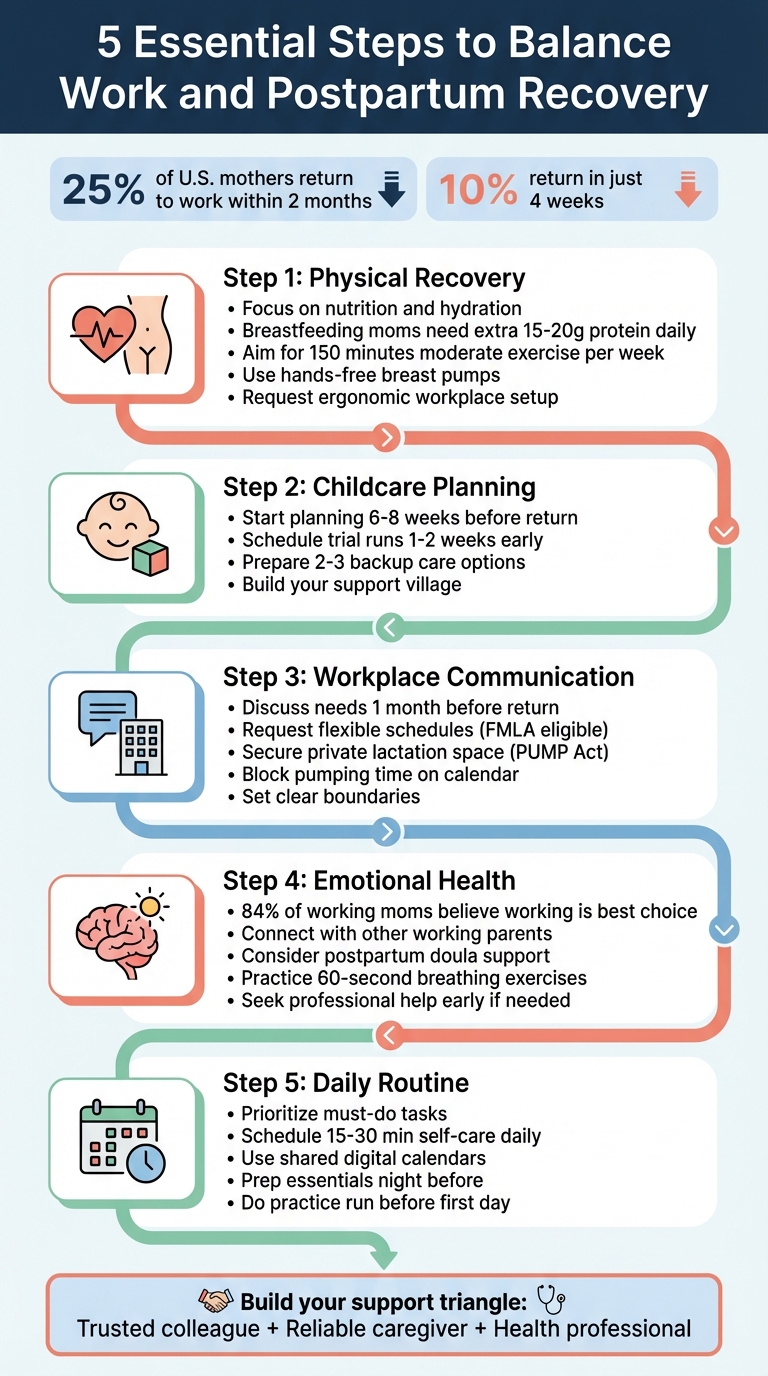
5 Essential Steps to Balance Work and Postpartum Recovery
Navigating the Transition Back to Work After Having a Baby
sbb-itb-9ce2258
Support Your Physical Recovery While Working
Returning to work after childbirth doesn’t mean your body stops its recovery process. Healing takes time, and balancing your health with job responsibilities can feel overwhelming. But with the right approach, you can support your postpartum recovery while staying productive. Here are some tips focused on nutrition, exercise, and practical tools to help you navigate this phase.
Eat Well and Stay Hydrated
Good nutrition is key, especially if you’re breastfeeding. As Chelsey Amer, MS, RDN, CDN, from HUM Nutrition points out:
"Without eating enough it's impossible for your body to heal. This is especially true if you're breastfeeding because you need enough energy to produce milk."
To support your recovery, focus on nutrient-rich foods. Iron helps replenish blood, protein aids tissue repair (breastfeeding moms need an extra 15–20 grams daily), calcium maintains bone strength, and choline supports your baby’s brain development. Incorporate options like lean meats, beans, tofu, dairy, kale, chia seeds, broccoli, eggs, fish, beef, or poultry into your meals.
Make things easier by prepping quick, protein-packed snacks like hard-boiled eggs or chia seed pudding. Keep grab-and-go options on hand, and always have a water bottle nearby to stay hydrated throughout the day.
Add Light Exercise and Prioritize Rest
Ease back into physical activity with short, manageable sessions. Aim for 150 minutes of moderate exercise per week - brisk walks are a great choice. They’re low-impact, easy to fit into a lunch break or commute, and can even help alleviate postpartum depression symptoms. Regular movement not only aids recovery but also helps you stay energized and focused at work.
Equally important is rest. Try syncing your sleep schedule with your baby’s and prepare the essentials the night before to make mornings less hectic. Before officially returning to work, do a practice run of your routine and commute to smooth out any challenges. If possible, consider negotiating a phased return or shorter work hours initially. On busy days, schedule short movement breaks and delegate household tasks to save energy for healing.
Use Body-Supportive Products
The right tools can make all the difference. Invest in pump-friendly clothing and hands-free breast pumps to simplify your day. These allow you to pump milk while multitasking, ensuring your baby’s needs are met without disrupting your workflow.
Keep spare pump parts in your bag and use an insulated cooler to store milk safely when a refrigerator isn’t available (milk stays fresh for up to 24 hours). Don’t hesitate to request workplace adjustments, such as an ergonomic pumping station or a footstool, to reduce swelling and improve comfort during long hours at your desk.
Arrange Reliable Childcare and Newborn Support
Finding dependable childcare is a cornerstone of easing your transition back to work. Knowing your baby is in safe hands not only ensures their well-being but also allows you to focus on your responsibilities without constant worry. Just as taking care of yourself is vital, securing reliable childcare plays a key role in maintaining your peace of mind during this phase.
Plan Your Childcare Options Early
Start exploring childcare options well in advance - ideally 6 to 8 weeks before your return to work. Whether you're considering daycare centers, nannies, or leaning on family support, take time to interview potential caregivers, check references, and visit facilities to ensure they align with your expectations and values. Once you’ve made your choice, consider scheduling trial runs. Allow your baby to spend a few hours or even half-days with the caregiver a week or two before your official return. If you're hiring a nanny, having them start 1–2 weeks early on a reduced schedule can give you a chance to observe how they interact with your baby and handle daily routines. These trial periods can help identify any concerns early and give you more confidence in your decision.
As Dana Hundley, Co-founder of Career Cooperative, puts it:
"If you have confidence that your little one is loved and cared for while you're not there, you're going to be a better, more relaxed person at work."
Use Expert Postpartum and Newborn Care Services
Professional newborn care services can be a game-changer, offering both practical help and emotional support during this adjustment period. Platforms like Nestling connect families with trained postpartum doulas, lactation consultants, and infant care specialists who assist with everything from diaper changes and bottle feeding to light housekeeping and meal preparation. These services allow you to focus on recovery, bonding with your baby, and balancing your work commitments.
Postpartum doulas, for example, can manage overnight care or daytime shifts, giving you the chance to rest or focus on work. Lactation consultants provide tailored advice on pumping schedules and milk storage - key for maintaining your milk supply while you're away from your baby. Infant care specialists also ensure your newborn’s safety and comfort, giving you peace of mind to concentrate on your job.
Nestling caregivers are thoroughly vetted through background checks, reference validation, and certification verification. The platform offers flexible scheduling options, whether you need immediate assistance or prefer to plan ahead. It even includes backup care arrangements for those unexpected moments.
Prepare Backup Plans for Emergencies
No matter how well-prepared you are, unexpected situations can arise - childcare disruptions, urgent work deadlines, or other emergencies. Having a backup plan can save you from unnecessary stress when these moments occur.
Identify two or three reliable backup options, such as family members, close friends, or professional agencies that offer emergency childcare. Prepare a guide for backup caregivers that includes details like your baby’s feeding and nap schedules, favorite songs, and cues (e.g., rubbing eyes when sleepy). Keep an emergency kit ready with extra clothes for both you and your baby, along with any essential supplies, and ensure everything is prepped the night before.
You can also connect with local parenting groups or nanny shares to expand your network of support. Building a community of parents who understand your situation can be invaluable during emergencies. As Abby Mscisz, Physician Assistant at Atrium Health Levine Children's Pediatric Extended Care, wisely notes:
"They say it takes a village, and that's the most accurate statement. Get involved in activities with other parents and kids so your village is wide and welcoming."
Talk to Your Employer About Your Needs
Once you’ve arranged childcare, it’s time to have a conversation with your employer about your postpartum needs. Starting this discussion early - ideally during your pregnancy or at least a month before you plan to return - gives everyone time to prepare. This allows your employer to arrange coverage, set up lactation spaces, and inform coworkers about any adjustments to your schedule. There’s no need for formal legal language or written requests; simply having an open conversation with your supervisor about your recovery or nursing needs is a good starting point. This discussion lays the groundwork for the specific requests you may need to make.
Ask for Flexible Work Options
Consider asking for flexible work arrangements, like remote work, modified hours, or a phased return. These options can be incredibly helpful as you recover. Under the Family and Medical Leave Act (FMLA), eligible employees can take leave intermittently or work reduced hours to care for a newborn. For example, you could propose working from home a couple of days a week or starting with shorter workdays and gradually increasing your hours. Since postpartum recovery varies from person to person, employers are encouraged to evaluate these requests individually.
As Heather, a working mom, explains:
"Everything related to childbirth and rearing is unpredictable and fluid and unique. So, you can't say, 'Everybody's going to do it this way.' You have to have some flexibility."
Request Workplace Accommodations
Once you’ve discussed flexible scheduling, focus on specific accommodations that support your recovery. Under the Pregnant Workers Fairness Act (PWFA), employers with 15 or more employees are required to provide reasonable adjustments for pregnancy and childbirth-related needs. This could include help with heavy lifting, extra breaks, or changes to physically demanding tasks.
For lactation, the PUMP for Nursing Mothers Act ensures that employers must provide reasonable break time and a private, functional space - separate from a bathroom - for pumping, up to one year after your child’s birth. Be clear about what you need, like a private space nearby with amenities for pumping, and discuss storage options for expressed milk. Blocking time on your work calendar for pumping sessions can also help avoid scheduling conflicts and reinforce that these breaks are essential.
If your employer isn’t familiar with lactation support, consider sharing resources like The Business Case for Breastfeeding to highlight how these accommodations benefit both employees and employers. And remember, under federal law, you don’t need a doctor’s note to request pumping breaks.
Set Clear Boundaries
Establishing boundaries is key. Communicate your off-clock hours and any schedule changes, like leaving early for childcare. Make it clear that you’ll need time off for postpartum medical appointments or therapy sessions if required.
Career coach Mary Beth Ferrante stresses the value of being upfront:
"The more open and direct you are about what's changing, the more people will respect your boundaries."
Finally, identify supportive coworkers or managers who can help you navigate HR policies and advocate for things like adequate lactation spaces. Having allies at work can make the transition smoother and show that both your personal and professional needs are recognized and respected.
Take Care of Your Emotional and Mental Health
Heading back to work during postpartum recovery isn’t just a physical challenge - it’s an emotional one, too. Many working moms wrestle with guilt, even though 84% believe that working is the best choice for themselves and their families. It’s a tricky emotional balancing act, made harder by hormonal changes, lack of sleep, and the constant pressure to excel at both work and motherhood. To navigate this, it’s important to have an emotional support plan in place, alongside the practical strategies you’ve already considered.
Handle Postpartum Anxiety and Guilt
"Mom guilt is: regardless of your efforts, there's always a sense that you could do more".
This feeling often peaks when you’re away from your baby for the first time. It’s normal, but it can be overwhelming.
Start by choosing childcare you trust completely. If you’re worried about your baby’s well-being, staying focused at work can feel impossible. Scheduling brief check-ins with your caregiver during the day can help ease some of that separation anxiety.
Be kind to yourself as you adjust. Career coach Mary Beth Ferrante offers this advice:
"It's important to be kind to yourself, and know that you're doing what you can with what you have at the moment you're in".
It’s okay if routines feel messy or simplified at first. Research shows no evidence that children are negatively impacted when their moms work outside the home, so try to let go of the need to be perfect in every role.
Connecting with other working parents - whether in your workplace or through online groups - can also provide reassurance and remind you that you’re not alone in these struggles.
Get Emotional Support Through Postpartum Care
Sometimes, self-help isn’t enough, and that’s where professional support can make a difference. Postpartum doulas and consultants specialize in guiding new moms through the emotional challenges of returning to work. They understand the “fifth trimester” - that tricky phase where physical recovery overlaps with redefining yourself as a working mother.
For example, Nestling’s postpartum doulas offer emotional support tailored to help you manage guilt, develop coping strategies for stressful days, and build confidence during this transition.
Set Realistic Expectations
Just as physical preparation is important, setting realistic emotional expectations is key to a smoother recovery. You don’t have to hit the ground running at full speed on your first day back - or even your first week. Dana Hundley, co-founder of Career Cooperative, puts it this way:
"You don't have to be perfect your first day back, your first week back, or really ever".
Focus on progress, not perfection. Start with small, manageable goals instead of trying to catch up on everything all at once.
If possible, consider returning midweek to ease into your new routine. Reassess your priorities and figure out which tasks truly need your attention right now. When taking on new projects, clarify deadlines and importance to avoid feeling overwhelmed. And don’t forget to block time for breaks and self-care - these aren’t luxuries; they’re necessities.
Keep an eye on your emotional well-being. Check in with yourself regularly to spot any signs of heightened anxiety or depression. Incorporate grounding exercises or deep breathing into your day, and carve out 15–30 minutes just for you - whether it’s savoring a quiet cup of coffee or enjoying a peaceful commute. Remember, you’re not alone in this. Over 25% of U.S. mothers return to work within two months of giving birth. You’re part of a resilient community navigating this same path.
Build a Daily Routine That Works
Once you've tackled managing your emotions, the next step is crafting a daily routine that minimizes decision fatigue. A well-thought-out routine not only simplifies your day but also gives you the mental space you need to focus. As Abby Mscisz, Physician Assistant at Atrium Health Levine Children's, puts it:
"A structured day creates predictability, which reduces stress and makes transitions smoother for everyone."
- Abby Mscisz, Physician Assistant, Atrium Health Levine Children's
This structure can act as the bridge between your recovery journey and the demands of your workday.
Focus on Must-Do Tasks
Start by pinpointing your non-negotiable tasks. Whether it's setting aside time for pumping or tackling key projects, block your calendar for these priorities. Avoid dealing with emails or work tasks in a scattered way - allocate specific time slots instead.
When new tasks come your way, try asking questions like, "When do you need this by? Is this a priority?" If it’s not urgent, be upfront: "I won’t be able to get that to you until the end of the week. Does that work?" This approach sets clear expectations without over-apologizing or overcommitting.
To help you stay grounded, consider building a "support triangle." This could include a trusted colleague at work, a dependable caregiver, and a health professional like a doula or therapist. These connections can act as your safety net when things feel overwhelming.
Make Time for Self-Care
Self-care doesn’t have to be elaborate. Even short breaks can make a difference. For instance, between tasks, try a quick 60-second breathing exercise: inhale for 4 counts, exhale for 6 counts, and repeat six times. This simple practice can help reduce stress and improve focus almost immediately.
Treat self-care as a priority by scheduling it into your day, just like you would a meeting. This could be a fitness class, a creative hobby, or even a peaceful solo trip to the grocery store. If mornings are your best time, consider waking up 30–60 minutes before your baby to enjoy a quiet coffee or dive into a good book. These moments aren’t indulgences - they’re vital for your well-being.
Using digital scheduling tools can also help you balance self-care with your daily responsibilities.
Use Time Management Tools
Lean on digital tools to ease your mental load. For example, set up a 20-minute weekly check-in with your partner to review the upcoming schedule. Cover childcare logistics, meal planning shortcuts, and any emergency arrangements during this time.
Shared calendars can be a lifesaver. Use them to block out pumping sessions, adding an extra 10–15 minutes for setup and cleanup. Simplify your mornings by prepping the night before - pack work and diaper bags, and lay out clothes to save time.
Before your first day back at work, consider doing a "dry run" of your morning routine. Go through everything, from your commute to childcare drop-off, to identify any potential timing issues. To wrap up your workday smoothly, set an alarm an hour before the end of your shift to finish tasks and touch base with colleagues.
As Heather, a working mother, wisely says:
"Everything related to childbirth and rearing is unpredictable and fluid and unique. So, you can't say, 'Everybody's going to do it this way.' You have to have some flexibility."
- Heather, Working Mother
Your routine doesn't have to be set in stone. Adjust it as needed to find what works best for you. These strategies can help you balance work and recovery, one day at a time.
Conclusion
Navigating the balance between work and postpartum recovery requires attention to your physical healing, emotional well-being, dependable childcare, and setting clear boundaries at work.
The strategies shared here - like treating your pumping sessions as non-negotiable calendar appointments or building a "support triangle" of trusted people - can help ease the transition. Small steps, such as practicing your morning routine ahead of time, holding weekly planning sessions with your partner, or taking quick 60-second breathing breaks between tasks, can make a noticeable difference. These practical and professional supports lay the groundwork for a smoother return to work.
Professional assistance can be a game-changer during this period. Services like Nestling connect you with vetted experts, including postpartum doulas and lactation consultants, to help manage daily challenges. This kind of support allows you to focus on healing and your career without feeling like you have to do it all on your own.
Dr. Portia Cohens from Atrium Health Women's Care emphasizes the importance of seeking help early:
"Seeking support early can make a significant difference in your recovery and overall well-being".
Don’t hesitate to reach out - to your employer, healthcare providers, or professional caregivers. Early action can lighten the load and set you up for success.
FAQs
How can I balance postpartum recovery while transitioning back to work?
Balancing postpartum recovery with returning to work can feel like a juggling act, but with thoughtful planning and the right support, it’s manageable. Start by having an open conversation with your employer. If possible, consider a gradual return - reduced hours or a flexible schedule can help you transition back into work while still focusing on your recovery.
Prioritize self-care by setting firm boundaries between your work and personal time. And remember, you don’t have to do it all alone. Reach out for help - whether it’s leaning on family and friends or turning to professional postpartum care services like those from Nestling. These services can help with your physical recovery, emotional well-being, and even light household chores, giving you the breathing room to care for your baby and stay on top of your career.
What are the best ways to balance work and postpartum recovery?
Balancing work and postpartum recovery can feel like a juggling act, but with thoughtful planning, it’s absolutely doable. Start by having an open conversation with your employer about what you need - options like flexible hours or remote work can make a big difference. Planning ahead is your best friend here. Arrange dependable childcare, establish a feeding or pumping routine if you’re breastfeeding, and, if possible, transition back to work gradually to ease the adjustment.
Your recovery - both physical and emotional - deserves priority too. Set clear boundaries and don’t hesitate to ask for help when you need it. Professional support can also be a game-changer. Postpartum doulas or lactation consultants, for example, can provide valuable guidance during this period. Platforms like Nestling are great resources to find trusted caregivers who specialize in postpartum and newborn care, offering services tailored specifically to your family’s needs. And above all, give yourself grace - patience and self-compassion are key as you find your rhythm in this new chapter.
How can I manage postpartum emotions and guilt while going back to work?
Feeling a mix of guilt or emotional struggles when heading back to work after having a baby? That’s completely normal. It’s important to acknowledge these feelings and treat yourself with kindness. Lean on your support network - whether that’s family, friends, or your partner - to help share responsibilities and lighten the emotional load. Joining local parenting groups or online communities can also be a great way to connect with other moms who understand what you’re going through.
Make self-care a priority and set realistic goals for yourself. Creating clear boundaries between your work and family life can help you find a sense of balance. If these emotions ever feel like too much to handle alone, don’t hesitate to seek professional support. For example, services like Nestling specialize in postpartum emotional care and can connect you with trusted caregivers to assist with both practical and emotional needs during this adjustment period. Taking care of yourself isn’t selfish - it’s essential for both you and your family to thrive.









 Sign up with Google
 Sign up with Facebook