
How to Budget for Postpartum Doula Services

How to Budget for Postpartum Doula Services
Welcoming a baby is exciting but can also be overwhelming. Planning ahead for postpartum doula services can help you manage this transition smoothly while avoiding financial surprises. Costs for doula services vary widely, with hourly rates ranging from $25 to $65, depending on location, experience, and the type of care needed (daytime vs. overnight). Here's what you need to know:
- Hourly Rates: Average is $25.91/hour, but it can be higher in urban areas like New York or Los Angeles.
- Packages: Many doulas offer bundles (e.g., 20–50 hours) for discounted rates.
- Additional Costs: Specialized services (e.g., overnight care, multiples support) and travel fees may apply.
- Budget Examples: Moderate overnight care (24 hours/week) can cost around $840 weekly.
To save, consider bulk packages, use HSA/FSA funds, or explore employer benefits. Start budgeting early in your pregnancy to ensure you're prepared for this important support.
How Postpartum Doulas Charge for Their Services
When planning for postpartum doula services, understanding how fees are structured is key. Most doulas charge hourly, with rates typically ranging from $25 to $65 per hour as of January 2026. The national average sits at $25.91 per hour, though prices can vary significantly depending on factors like location and the doula's expertise.
Many doulas require a retainer fee upfront to secure your due date. Additionally, some may have minimum shift requirements, often asking for a commitment of at least 4 to 8 hours per visit.
Hourly Rates vs. Package Deals
While hourly rates are common, many doulas also offer package deals that can lower the average hourly cost. These packages often include bundles of 20, 40, or even 80 hours, which can be used over a period of weeks. For families, purchasing a package can simplify billing and provide a more cost-effective option.
What Affects Pricing
Several factors influence the cost of hiring a postpartum doula. Location plays a significant role. For instance, in New York City, starting rates are around $30.52 per hour, which is about 19% higher than the national average. Conversely, rates in smaller towns or rural areas can range between $20 and $35 per hour.
Experience level also impacts pricing. Entry-level doulas with less than one year of experience typically charge around $22.25 per hour, while seasoned professionals earn approximately 16% above the national average. Specialized services, such as "awake care" during overnight shifts - where the doula remains alert all night - add an extra $5 to $15 per hour to standard rates. Similarly, if you're expecting multiples, you may encounter an additional surcharge of $5 to $10 per hour.
| Experience Level | Hourly Rate |
|---|---|
| Entry Level (<1 year) | $22.25 |
| Early Career (1–4 years) | $25.60 |
| Experienced | ~$30.00+ (16% above the average) |
Source: Payscale (January 2026)
For families seeking overnight care to maximize rest, hourly rates are typically higher, ranging from $30 to $80 per hour, compared to $25 to $50 per hour for daytime support.
sbb-itb-9ce2258
How to Calculate Your Postpartum Doula Budget
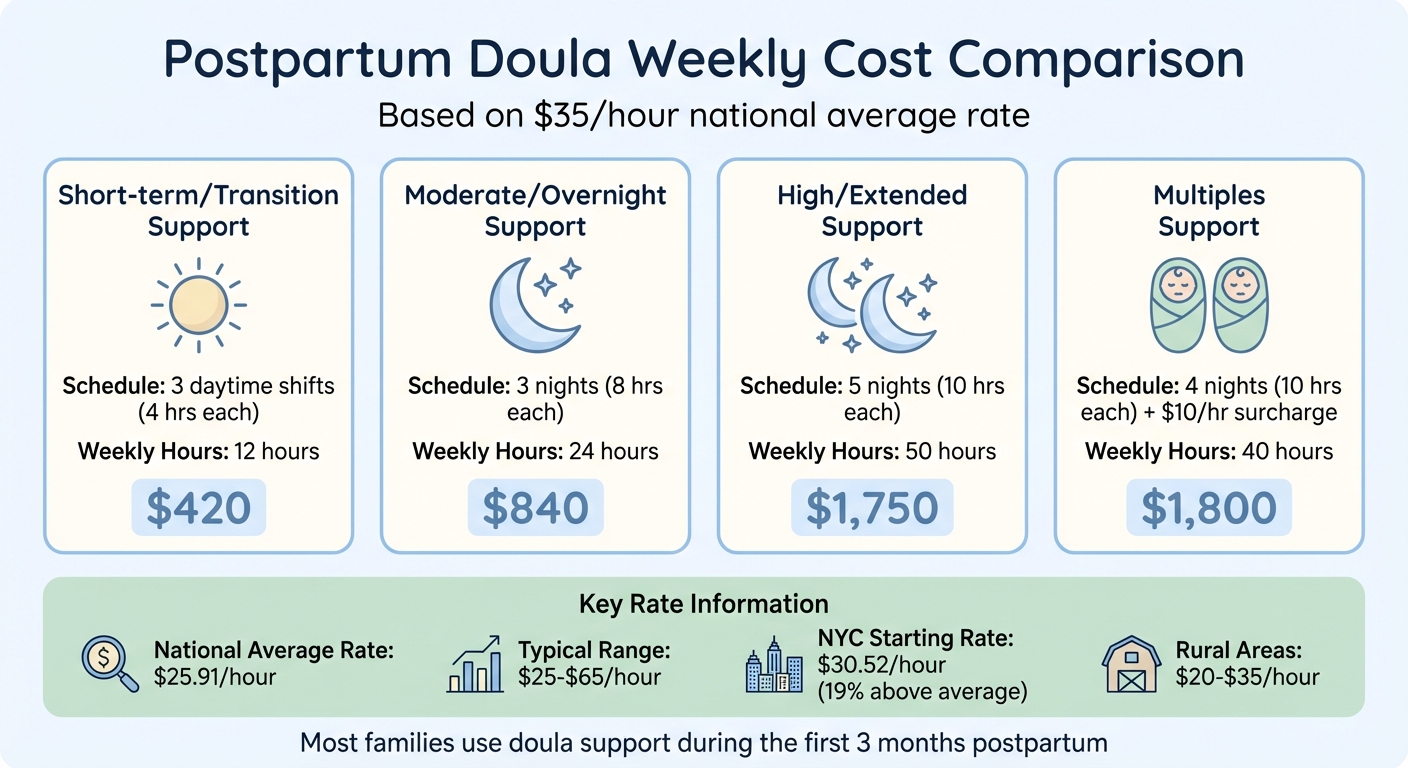
Postpartum Doula Cost Breakdown by Support Level and Weekly Hours
Figuring Out How Much Support You Need
Start by mapping out your partner's leave schedule to identify the weeks you'll be handling newborn care on your own. These "gap" periods are when having a postpartum doula can be especially helpful.
Consider your specific recovery needs and family situation. For example, recovering from a cesarean, managing a high-risk pregnancy, caring for multiples, or juggling an older child might all increase the amount of support you'll need.
Next, decide whether you’ll benefit more from daytime or overnight shifts. Daytime shifts - typically around 4 hours - are great for help with household chores, meal preparation, and breastfeeding guidance. Overnight shifts, lasting 8–12 hours, focus on sleep support and assisting with nighttime feedings. Many families book overnight care for 3 to 5 nights per week over a span of 6 to 12 weeks. Keep in mind that doulas often have minimum hourly requirements per shift or week.
Once you've assessed your needs, you're ready to calculate the cost.
Calculating Total Costs
To estimate your postpartum doula budget, multiply the hourly rate by the weekly hours and the total number of weeks you plan to hire support. For example:
$40/hour × 20 hours/week × 4 weeks = $3,200.
Most families rely on doula support during the first three months after birth, gradually reducing the frequency as they adjust to life with a newborn.
Here’s a snapshot of weekly costs based on the national average rate of $35 per hour:
| Level of Support | Typical Schedule | Estimated Weekly Hours | Estimated Weekly Cost |
|---|---|---|---|
| Short-term/Transition | 3 daytime shifts (4 hrs each) | 12 hours | $420 |
| Moderate/Overnight | 3 nights (8 hrs each) | 24 hours | $840 |
| High/Extended | 5 nights (10 hrs each) | 50 hours | $1,750 |
| Multiples Support | 4 nights (10 hrs each) + $10/hr fee | 40 hours | $1,800 |
This table provides a helpful guide to estimate costs based on your preferred level of support.
Other Costs to Include in Your Budget
Taxes and Travel Fees
When budgeting, don’t overlook the possibility of taxes and travel-related fees. If you live in a rural area or need your doula to travel a long distance, you might face additional charges for mileage or travel time. These fees can vary depending on your location and the doula's specific travel policies, so it’s a good idea to discuss this during your initial consultation. Also, check whether your state applies sales tax to doula services, as this may not be included in the initial quote.
Backup Care and Specialized Services
Backup care and specialized services can also add to your overall costs. While many doulas include backup care in their standard pricing, it’s worth confirming how they handle situations where they might be unavailable. As Alec Pow, an economic and pricing investigator, explains:
"Fees help cover on-call backup doulas for rare cases when a doula can't attend a birth herself".
If you’re seeking specialized services, be prepared to pay premium rates. For instance, care for multiples often costs an additional $5–$10 per hour. Services like placenta encapsulation, belly binding, or sibling care are typically billed as separate add-ons.
To budget effectively, consider using tools like Nestling, which offer clear pricing and detailed service agreements to help you plan with confidence.
Ways to Reduce Postpartum Doula Costs
Buy Hours in Bulk for Discounts
Purchasing doula hours in bulk can save you between $50 and $100. Many providers offer discounted rates when you commit to packages ranging from 20 to 50 hours. For instance, a 20-hour daytime package might cost $850 instead of $900, while a 50-hour package combining day and night shifts could be $2,275 instead of $2,375. Keep in mind that most doulas require a minimum booking of 10–16 hours. Services like Nestling provide clear package pricing, making it easier to plan. To make the most of these savings, carefully organize your schedule.
Schedule Services Strategically
Focus on scheduling intensive doula support during the first two weeks postpartum. Many families start with more frequent visits during this period and gradually taper off as they become more comfortable. You can also cut costs by mixing shift types - daytime visits are generally less expensive than overnight care. For overnight shifts, keep in mind that “awake care” often adds an extra $5–$15 per hour to the base rate. To save money, prioritize nights when extra help is most needed rather than booking nightly support.
Look Into Insurance or Employer Benefits
Beyond adjusting your service package, explore additional payment options. Many doula services are eligible for reimbursement through HSAs, FSAs, HRAs, or Medicaid in certain states. To improve your chances of approval, request a Letter of Medical Necessity from your doctor. Check with your HR department to see if your employer offers family benefits or programs like Carrot Fertility, which may cover doula costs.
"As postpartum doulas, we've helped dozens of families use Carrot Fertility and get reimbursement for doula support, making our services completely free of charge to you." – Bountiful Doulas
Even if doula services aren’t explicitly covered, many families secure partial reimbursements by submitting a detailed superbill along with a Letter of Medical Necessity. As of June 2024, Medicaid provides coverage for doula care in 14 states, including California, Florida, Michigan, New York, and Washington D.C..
Building Your Postpartum Support Budget
Once you’ve got a rough idea of your costs, it’s time to shape your postpartum support budget in a way that works for you.
Deciding What to Prioritize
Start by sorting out what’s absolutely necessary from what’s nice to have. Essentials might include things like recovery support, feeding help, and emotional care. Extras could be services like overnight care or meal preparation. Make a list of what matters most to you and your family.
Next, take a look at your net income. Factor in any paid leave, contributions from family or your community, and, if you’re planning on unpaid leave, try simulating that reduced income now. Setting aside a dedicated postpartum fund can make a big difference.
"A budget is a plan, not a guarantee! ... Use a low/high estimate for all estimates and incomes so that you can see the best and worst case scenarios." – Jessalyn Ballerano, Certified Childbirth Educator & Doula, Seven Starling
To prepare for the unexpected, create both low and high estimates for your expenses. Add a cushion for surprise costs - it’s better to have a little extra wiggle room than to come up short. This approach gives you a clearer sense of what to expect and helps you stay ready for any financial curveballs.
Monitoring and Adjusting Your Budget
Your needs will shift over time, so it’s important to check in on your budget regularly. A monthly review can help you stay on track and adjust as your postpartum journey evolves. Many families find the 50/30/20 rule helpful: allocate 50% of your income to essentials (like doula care, diapers, and childcare), 30% to discretionary wants, and 20% to savings or paying off debt.
As your situation changes, you might scale back on some services. For example, you could reduce full-time care to a few days a week after the first month. Platforms like Nestling offer flexible scheduling, making it easier to adjust while keeping access to trusted caregivers.
If your recovery takes longer than you anticipated, consider shifting funds from one-time expenses, like nursery furniture, to ongoing needs such as lactation support or specialized care. Keep detailed receipts and, if applicable, get a Letter of Medical Necessity from your healthcare provider. This documentation can help you get reimbursed through your HSA, FSA, or insurance. Some families even include a “doula fund” on their baby registry, allowing loved ones to chip in and give you more financial breathing room.
"Becoming a parent will keep your finances in flux for years to come. You're in for a challenging ride. Stay calm. When it comes to budgeting for parenthood, the keys are equal parts preparedness and flexibility." – NerdWallet
Conclusion
Start planning for postpartum doula services early by looking into local rates, assessing your budget, and figuring out how many hours of support you'll need. Once you have a clear picture, consider ways to make this care more affordable - options like purchasing hours in bulk, using HSA or FSA funds, or even adding a doula fund to your baby registry can help ease the financial burden.
Taking these steps ensures you can access the support that truly makes a difference. Research shows that having a doula positively impacts the well-being of both parents and babies.
"Investing in postpartum and newborn care support can have long-lasting benefits for your physical and emotional well-being, as well as the overall health and happiness of your family." – Lauren Foster, Founder, National Baby Co.
As your postpartum journey unfolds, revisit your budget to make adjustments based on your evolving needs. You might tweak your support hours or reallocate funds as your recovery progresses. Be sure to keep detailed receipts and records, as these could help with insurance claims or reimbursements through tax-advantaged accounts.
Once you're ready, head over to Nestling to find postnatal care from certified caregivers and book flexible care that allows you to focus on healing and cherishing time with your family.
FAQs
How do I estimate the cost of hiring a postpartum doula?
To get a sense of what hiring a postpartum doula might cost, start by looking into the typical hourly rates in your area. These usually range from $25 to $60 per hour, depending on where you live and the doula’s level of experience. For example, rates in the Midwest tend to be on the lower end, while areas like the Northeast and West Coast often see higher prices.
Once you know the hourly rate, figure out how much support you’ll need. Are you looking for daytime assistance, overnight care, or a mix of both? Multiply the hourly rate by the total hours you plan to book. For example, if you need 8 hours of care each day for 2 weeks (112 hours total), the cost could range from $2,800 to $6,720, depending on the rate. Keep in mind that specialized services, such as care for a medically fragile baby, might come with extra fees.
If you’re unsure where to start, platforms like Nestling can connect you with vetted postpartum doulas and offer flexible options to suit your budget. After calculating your estimated costs, compare them to your household budget and adjust the hours or services as needed to make it work financially.
What should I consider when deciding between daytime and overnight postpartum doula support?
When deciding between daytime and overnight doula support, it’s important to consider your family’s unique needs and daily routine. Overnight doulas focus on nighttime care, including feeding, diaper changes, soothing, and helping your baby establish better sleep patterns. This allows parents to catch up on much-needed rest. In contrast, daytime doulas provide support during waking hours, assisting with newborn care, lactation guidance, emotional support, and even light household tasks.
Cost is another key factor. Overnight doulas typically charge between $30 and $80 per hour, while daytime rates usually fall in the range of $35 to $60 per hour. Be sure to also take into account the doula’s level of experience, availability, and any additional fees, such as travel expenses or extended hours. Weighing these considerations will help you determine which option aligns best with your family’s needs and budget.
How can I save money when hiring a postpartum doula?
There are plenty of ways to make hiring a postpartum doula more budget-friendly without sacrificing the quality of care you receive. Start by checking if the doula or agency provides payment plans or sliding-scale pricing to help spread out the cost. It's also worth exploring whether your health insurance or flexible spending account (FSA) might cover part of the expense - review your benefits to see what’s included.
Another option is to hire a newer or apprentice doula, who often charges lower rates while still offering valuable support. You might also save money by booking fewer hours, perhaps focusing on the critical first few weeks after birth. Sharing a doula with another family is another creative way to cut costs. Keep an eye out for package deals that bundle services like prenatal visits, postpartum care, and newborn support at a reduced rate.
If you're using a platform like Nestling, you can take advantage of flexible booking options and personalized care plans. This allows you to choose only the services you need, helping you avoid unnecessary expenses. Nestling also ensures all caregivers are thoroughly vetted, so you can feel confident about getting reliable support while keeping your budget in check.










 Sign up with Google
 Sign up with Facebook