
Baby Won't Sleep? 8 Expert Solutions

Baby Won't Sleep? 8 Expert Solutions
Struggling with a sleepless baby? You're not alone. Sleep challenges are common for new parents, but there are practical ways to improve your baby's sleep habits. Here are 8 expert-backed strategies to help your baby - and you - get better rest:
- Bedtime Routine: A consistent routine signals it's time to sleep. Include calming activities like a warm bath, dim lights, and quiet time.
- Sleep Environment: Ensure safety with a firm mattress, no loose bedding, and a room temperature of 68–72°F. Use white noise and keep the room dark.
- Self-Soothing: Teach your baby to fall asleep independently by placing them in the crib drowsy but awake. Methods like the Ferber or Pick Up/Put Down can help.
- Swaddling & Pacifiers: Swaddle younger babies to reduce the startle reflex, and use pacifiers to soothe (while following safety guidelines).
- Feed-Play-Sleep Cycle: Feed after waking, engage in active play, and encourage sleep when tired cues appear.
- Bedtime Massage: Gentle massages can calm your baby, improve digestion, and promote deeper sleep.
- Professional Help: If sleep issues persist, consider consulting infant care specialists for tailored support.
These methods work best with consistency and patience. If you're still struggling after a few weeks, seek guidance from a pediatrician or sleep expert.
Solution 1: Set Up a Consistent Bedtime Routine
Why Routine Matters
Creating a consistent bedtime routine helps signal to your baby that it's time to sleep. Studies have shown that predictable routines not only reduce night awakenings but also help ease separation anxiety. They can also encourage longer stretches of sleep, giving both you and your baby much-needed rest.
Starting a routine early can align your baby's developing internal clock with the rhythms of the day and night.
"Follow the routine every night and your baby will begin to understand when it's time to sleep." - Heidi Szugye, DO, IBCLC, Pediatrician, Cleveland Clinic
So, how do you create this bedtime routine? Let’s break it down.
How to Build a Bedtime Routine
The key is simplicity. A 15–30 minute routine of calming activities is often enough. While you can start introducing a bedtime rhythm as early as 2 months, the ideal time to establish a formal routine is between 4 and 6 months, when your baby’s circadian rhythm starts to develop.
Here’s a step-by-step guide:
- Start with a warm bath: Giving your baby a bath 60–90 minutes before bedtime can help. The rise and subsequent drop in body temperature naturally promotes sleepiness.
- Dim the lights: After the bath, lower the lighting in the room to encourage melatonin production, which helps your baby wind down.
- Quiet activities: Engage in soothing activities like reading a short book or singing a lullaby. These help your baby transition into a calmer state.
- Feed strategically: Offer a feeding about 15 minutes before placing your baby in the crib. This can prevent hunger-related wake-ups but avoids creating a habit of needing to feed to fall asleep.
- Drowsy but awake: Lay your baby down when they’re drowsy but still awake. This helps them learn to self-soothe and fall asleep independently, an essential skill for better sleep.
- Use a consistent "sleep signal": Some parents find it helpful to say a simple phrase like "I love you, sweet dreams" as a final cue that it’s time for sleep.
"Consistency really is the key. Once you get a routine that works, stick with it. You don't want to make drastic changes that could disrupt the routine or lead to new, bad habits." - Heidi Szugye, DO, IBCLC, Pediatrician, Cleveland Clinic
For nighttime diaper changes, use a red light. Babies don’t perceive red light the way they do other colors, so it helps them stay in a sleepy state. And remember, avoid screen exposure before bedtime - even a few minutes can interfere with their sleep patterns.
sbb-itb-9ce2258
How to Get a Baby to Sleep: Tips from Pediatrician Dr. Gurinder Dabhia | San Diego Health
Solution 2: Create the Right Sleep Environment
Your baby's sleep environment plays a big role in both their safety and sleep quality. Let’s dive into how to make their space secure and sleep-friendly.
Safe Sleep Practices
Safety should always come first when setting up your baby’s sleep area. In 2022, the U.S. reported roughly 3,700 sleep-related infant deaths, but following safe sleep guidelines can significantly reduce these risks. Always put your baby to sleep on their back, alone, on a firm, flat mattress with only a snug-fitting sheet. Keep the area free from pillows, blankets, bumper pads, and stuffed animals.
"A firm sleep surface helps reduce the risk of SIDS and suffocation." - CDC
Room-sharing - without bed-sharing - is highly recommended. Keeping your baby’s crib or bassinet in your room for at least the first six months can lower the risk of SIDS by up to 50%. On the other hand, not room-sharing increases the likelihood of sleep-related suffocation by over 18 times. If you’re worried about keeping your baby warm without loose blankets, consider using a wearable blanket or sleep sack. Avoid weighted sleepwear, swaddles, or regular blankets, as these are unsafe for infants.
Once safety is covered, you can focus on creating a comfortable sleep environment.
Best Room Conditions
After ensuring the space is safe, make the room as comfortable as possible. Start with the temperature. The ideal range for your baby’s room is 68–72°F, which helps prevent overheating - a known risk factor for SIDS.
"The recommended temperature for a baby's room is between 68-72 degrees Fahrenheit." - Stefanie Rogers, MOT, OTR, Occupational Therapist at Children's Health
Keep an eye on your baby’s body temperature by checking their chest or back. Signs of overheating include sweating, a flushed face, or a warm chest. A good rule of thumb is to dress your baby in one layer more than what keeps you comfortable.
Lighting and noise also play a role in better sleep. Keep the room dark at night to encourage melatonin production. If you need light for nighttime diaper changes, use a dim red bulb - it’s less disruptive. During the day, expose your baby to plenty of bright, natural light to help establish their circadian rhythm.
White noise can be a lifesaver for blocking out household sounds that might wake your baby. Just make sure the volume stays no louder than a running shower. This steady sound mimics the comforting rhythm of the womb and can make it easier for your baby to drift off to sleep.
Solution 3: Teach Self-Soothing Techniques
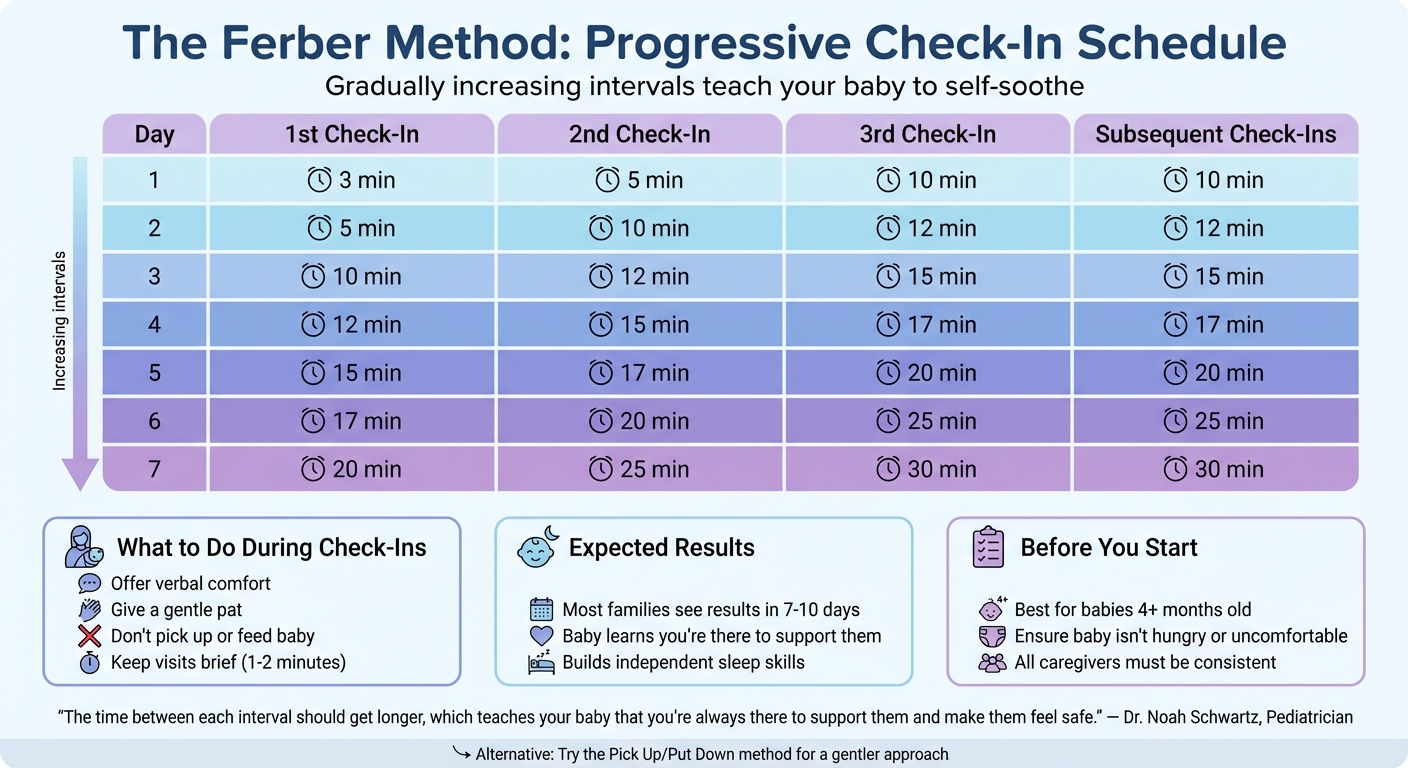
Ferber Method Sleep Training Schedule: 7-Day Check-In Intervals
Once you've established a consistent bedtime routine and created an ideal sleep environment, the next step is to help your baby learn how to self-soothe.
Self-soothing is your baby's ability to fall asleep - or get back to sleep - on their own. It's a skill that develops over time. Most experts suggest waiting until your baby is at least 4 months old to start formal sleep training, as younger infants haven't yet developed the emotional regulation or steady sleep patterns required for self-soothing. By the time they reach 6 months, many healthy babies can sleep through the night without needing to feed.
To encourage self-soothing, begin by placing your baby in their crib while they're still drowsy. This helps them associate the crib with sleep. Make sure they aren't crying due to hunger, a dirty diaper, or discomfort. Consistency among caregivers is also crucial for success.
Research shows that sleep training methods like graduated extinction do not negatively impact the bond between parent and child or a child's behavioral development at 18 months. In fact, successful sleep training can often ease caregiver stress and reduce feelings of depression.
There are two popular approaches to teaching self-soothing, each with its own style and pace.
The Ferber Method
The Ferber Method, also known as graduated extinction, involves putting your baby in their crib while they're awake and leaving the room. If they cry, you'll wait for a set amount of time before checking on them. During check-ins, you can offer verbal comfort and a gentle pat, but avoid picking them up or feeding them.
"The time between each interval should get longer, which teaches your baby that you're always there to support them and make them feel safe." - Noah Schwartz, MD, Pediatrician
Below is an example of a check-in schedule:
| Day | 1st Check-In | 2nd Check-In | 3rd Check-In | Subsequent Check-Ins |
|---|---|---|---|---|
| Day 1 | 3 minutes | 5 minutes | 10 minutes | 10 minutes |
| Day 2 | 5 minutes | 10 minutes | 12 minutes | 12 minutes |
| Day 3 | 10 minutes | 12 minutes | 15 minutes | 15 minutes |
| Day 4 | 12 minutes | 15 minutes | 17 minutes | 17 minutes |
| Day 5 | 15 minutes | 17 minutes | 20 minutes | 20 minutes |
| Day 6 | 17 minutes | 20 minutes | 25 minutes | 25 minutes |
| Day 7 | 20 minutes | 25 minutes | 30 minutes | 30 minutes |
Most families see results in about 7 to 10 days. However, if your baby becomes overly upset during the timed intervals, you might want to explore a different method.
The Pick Up/Put Down Method
If you're looking for a gentler approach, this method might be a better fit. It works well for babies between 4 and 8 months old. When your baby cries, pick them up and soothe them until they're calm - but not asleep. Once they're settled, place them back in the crib. Repeat this process until your baby falls asleep.
"If you give your baby some attention without holding them, they learn that being put down isn't a bad thing." - Matthew Badgett, MD, Pediatrician
"Self-soothing is really co-soothing because the parent is still involved. Your baby plays a more active role in soothing, but you set them up for success." - Dr. Matthew Badgett, Pediatrician, Cleveland Clinic
Unlike the Ferber Method, the Pick Up/Put Down approach includes physical contact, offering extra reassurance along with verbal comfort. It may take more time to see results compared to the Ferber Method, but it can feel less overwhelming for parents. Regardless of the method you choose, always give your baby a moment to adjust before intervening - they might just be shifting between sleep cycles.
Solution 4: Use Swaddling and Pacifiers
Swaddling and pacifiers can help your baby sleep more peacefully. Swaddling works by calming your baby and reducing the startle reflex, while pacifiers satisfy their natural sucking instinct, releasing calming endorphins and creating a sense of comfort. Studies also indicate that using a pacifier during sleep can significantly reduce the risk of SIDS (Sudden Infant Death Syndrome).
Safe Swaddling Techniques
When swaddling, always place your baby on their back to sleep. Wrap the blanket snugly around their upper body but leave their hips and legs free to move - this helps prevent hip dysplasia. Steer clear of weighted swaddles, sleepers, or blankets, as these can pose safety risks. Instead, ensure your baby sleeps on a firm and flat surface, like a crib or bassinet mattress with a fitted sheet. Make sure the swaddle stays below their shoulders to avoid overheating or covering their head.
It's essential to stop swaddling as soon as your baby starts showing signs of rolling over, which can happen as early as 2 months. Rolling over while swaddled increases the risk of suffocation and SIDS.
"Don't use swaddling if your baby is 2 months or older, or if your baby can roll over on their own. Swaddling may raise the risk for SIDS... if the swaddled baby rolls onto their stomach." - Johns Hopkins Medicine
Introducing a Pacifier
Pacifiers provide another effective way to soothe your baby. If you're breastfeeding, it’s recommended to wait until your baby is around 3 to 4 weeks old - after nursing is well-established - before introducing a pacifier. For bottle-fed babies, pacifiers can be used from birth. Opt for a one-piece pacifier to reduce choking hazards, and avoid attaching it to strings, clips, or stuffed toys, as these can create strangulation risks.
To help your baby accept a pacifier, try gently rubbing the center of their tongue in small circles to stimulate their sucking reflex. Keep the pacifier clean, and avoid "cleaning" it by putting it in your mouth, as this can spread germs. Experts generally recommend weaning your child off the pacifier between 6 months and 3 years to reduce the chances of dental or ear problems.
Solution 5: Follow the Feed-Play-Sleep Cycle
The Feed-Play-Sleep cycle is a simple routine designed to help your baby develop a natural sleep rhythm. The idea is to feed your baby right after they wake up, engage them in active play, and then encourage sleep when they show signs of tiredness. This approach helps break the common "feed-to-sleep" habit, teaching your baby to fall asleep without relying on nursing or a bottle. By incorporating sunlight and social interaction during playtime, your baby's circadian rhythm can begin to regulate itself - often by the time they are 8 to 9 weeks old. Keeping your baby active during the day also reduces the likelihood of them wanting to stay awake at night.
"When the foundation of adequate sleep is laid during the day, and the child is not overtired, they can consolidate their sleep cycles together at night with fewer wake-ups." - Nilong Vyas, MD, MPH, Pediatrician
Recognizing Tired Cues
Understanding your baby's tired signs is key to this cycle. Early signs of tiredness might include reduced activity, a blank stare, red eyebrows, or becoming less vocal. Mid-stage signs include yawning, rubbing eyes, pulling at ears, or sucking on fingers. If you miss these, your baby might reach the late stage, which is marked by intense crying, back arching, or hyperactivity - indications they are overtired and may struggle to settle down.
For newborns, tiredness usually sets in after 60 to 90 minutes of wakefulness. Babies between 3 and 6 months often show tired cues after being awake for 1.5 to 2.5 hours. If your baby becomes fussy within two hours of feeding, it’s often a sign they’re ready for sleep.
How to Structure the Cycle
Start each cycle by feeding your baby as soon as they wake up. This ensures they’re well-fed and ready for the next phase: play. During playtime, choose activities that match their age, such as tummy time, reading, singing, or taking a walk outside. Exposure to natural light during this period can help regulate their internal clock.
When you notice tired cues like yawning or rubbing their eyes, it’s time to prepare for sleep. Dim the lights, reduce noise, and place your baby in their crib while they’re still awake but drowsy. This helps them learn to fall asleep on their own. Limit naps to about two hours to ensure they’re ready for longer, more consolidated sleep at night.
"If your baby doesn't have enough active awake time during the day, they will want it at night." - Newton Baby
This cycle works well alongside other sleep strategies, helping to establish consistent and healthy sleep habits for your baby.
Solution 6: Try Gentle Bedtime Massage
Adding a gentle bedtime massage to your baby's nighttime routine can work wonders in helping them relax and prepare for sleep.
A soothing massage before bed encourages your baby to unwind by increasing oxytocin and melatonin levels while lowering cortisol, the stress hormone. Studies suggest that babies who receive a massage at bedtime produce more melatonin, experience fewer night wakings, and develop deeper, more consistent sleep patterns.
But the benefits don’t stop at better sleep. Massage can also relieve muscle tension, ease gas, and even help with constipation and colic. Gentle clockwise strokes on your baby’s tummy, in particular, can support digestion and provide relief. It’s recommended to wait until your baby is at least 10 to 14 days old before starting massage, as their skin needs time to mature. Also, ensure you wait at least 45 minutes after feeding to avoid discomfort.
"Infants thrive on touch – it's a way that parents can connect with their baby in a nurturing way... touch is an essential nutrient for growth." - Bubzi Co
Massage Techniques for Relaxation
- Prepare the setting: Warm your hands and baby-safe lotion in warm water. Create a calming atmosphere with soft lighting and gentle music or white noise.
- For the tummy: Use the "I Love You" method. Trace an "I" on the right side of your baby’s abdomen, then an inverted "L", and finally an inverted "U" in a clockwise direction. This can help relieve gas and support digestion.
- For the arms and legs: Gently squeeze and stroke from the body outward toward the hands and feet. This promotes relaxation and circulation.
- For the back: Use long, smooth strokes from the neck down, avoiding direct pressure on the spine.
Avoid massaging your baby’s face and chest, especially when they’re very young. Never press directly on the spine, and always stop if your baby seems uncomfortable or upset. Additionally, skip lavender oil during massages due to its potential hormonal effects.
The key to success is consistency. Regularly incorporating massage into your bedtime routine can amplify its calming effects, making it a valuable part of your baby’s sleep schedule.
Solution 7: Get Help from Nestling Infant Care Specialists

Sometimes, even with your best efforts, tackling persistent sleep issues requires a little expert help. That’s where Nestling’s infant care specialists come in. They offer personalized support to help streamline your baby’s sleep routine and ease your parenting journey.
Why Professional Support Can Make a Difference
Professional help can bring the consistency that’s often hard to maintain when you’re an exhausted parent. Nestling specialists work closely with families to create healthy sleep habits and bedtime routines tailored specifically to your baby’s needs. Their approach complements self-soothing techniques and other strategies you may already be using. On top of that, they keep detailed records of feeding schedules, diaper changes, and sleep patterns, so you can track progress effectively.
These experts also help you identify early signs of tiredness - like eye rubbing or fussiness - so you can get your baby to sleep before they become overtired. And if you’re navigating the emotional hurdles of methods like "cry it out", they’ll guide you in choosing an approach that aligns with your family’s comfort level. With consistent guidance, many babies can adapt to sleep training in as little as three to four nights.
"Booking Janet through Nestling? Best. Decision. Ever. For six weeks, she was our nighttime superhero, letting me actually sleep and heal." - Sophia L.
Care Plans That Fit Your Needs
Nestling offers flexible care plans to suit different family situations. Their Basic Care package covers essential newborn support, including sleep routines, feeding, and bathing. For more comprehensive help, the Advanced Care plan includes postpartum services like lactation support and specialized care.
If you need immediate relief, you can book overnight shifts ranging from 8 to 12 hours (e.g., 9:00 PM to 7:00 AM) for several nights or even up to six nights a week. The cost for these services typically ranges from $25 to $60 per hour, depending on the specialist’s experience and the duration of care. To explore your options and find the right fit for your family, visit getnestling.com.
Conclusion
Helping your baby sleep better is entirely possible. By incorporating strategies like establishing a consistent bedtime routine, creating a safe sleep environment, encouraging self-soothing, using swaddling or pacifiers, following meaningful feeding cycles, offering gentle massages, and seeking expert advice when needed, you can build healthy sleep habits for your little one. Following the feed-play-sleep cycle, recognizing signs of tiredness, and using calming techniques such as gentle massage can help your baby learn to sleep more independently.
These methods work together to improve sleep patterns. As pediatrician Dr. Nilong Vyas notes, "When the foundation of adequate sleep is laid during the day, and the child is not overtired, they can consolidate their sleep cycles together at night with fewer wake-ups". Most sleep challenges in infants can be resolved with consistent training and limit-setting in less than three weeks.
Sleep difficulties are common, affecting up to 50% of children. While most babies start sleeping through the night (6 to 8 hours) between 3 and 6 months of age, every child progresses at their own pace.
If you've been consistent with these strategies for two to three weeks without seeing improvement, it’s a good idea to seek professional help. Whether it’s reaching out to your pediatrician or consulting Nestling's infant care specialists, expert guidance can provide the personalized support needed to refine your approach.
FAQs
How can I tell if my baby is overtired, and what can I do to help?
An overtired baby often shows telltale signs like rubbing their eyes, becoming clingy, or acting irritable. They might cry more intensely, seem unusually hyperactive, or appear overly alert despite being clearly tired. These behaviors usually mean they’ve been awake too long or are overstimulated, which can make it harder for them to settle down.
When you notice these signs, it’s important to respond quickly by helping your baby wind down for sleep. Start with a calming pre-sleep routine - dim the lights, offer a gentle cuddle, or sing a soothing lullaby. Techniques like rocking, swaddling (if it’s still age-appropriate), or giving them a pacifier can also help them relax. Keeping track of your baby’s wake windows - typically 1.5 to 2 hours for infants around 3–4 months old - can help you avoid overtiredness altogether. Sticking to consistent nap and bedtime routines will also encourage healthier sleep habits over time.
How can I start a bedtime routine for my newborn?
Establishing a bedtime routine for your newborn revolves around keeping things calm, cozy, and predictable. Begin with a relaxing activity, like a warm bath, a gentle massage, or swaddling. These actions can signal to your baby that it’s time to settle down. Make sure the room is dimly lit, quiet, and comfortably cool - somewhere between 68–72°F - to create a soothing environment.
Once you’ve completed the calming activity, place your baby in their crib while they’re still awake but feeling drowsy. This helps them start developing the ability to fall asleep independently. Follow the same steps every night - like bath, swaddle, lullaby, and crib - so your baby starts to recognize and feel comforted by the routine. It might take some time, but consistency will help them adjust.
When should I reach out to a professional about my baby's sleep problems?
If your baby continues to struggle with sleep past the usual developmental milestones - like frequent night wakings or difficulty self-soothing after 3 to 6 months - it might be worth reaching out to a professional. Other warning signs to keep an eye on include breathing problems during sleep, unusual daytime sleepiness, or if these sleep disruptions are affecting your baby's growth, development, or even your family's overall quality of life.
A pediatrician or sleep specialist can offer valuable insights and personalized strategies to tackle these challenges. Taking action early can have a positive impact on both your baby and your family’s daily life.








 Sign up with Google
 Sign up with Facebook